SHAWORDS
Cold War

Cold War

Cold War

Cold War

author
62Quotes

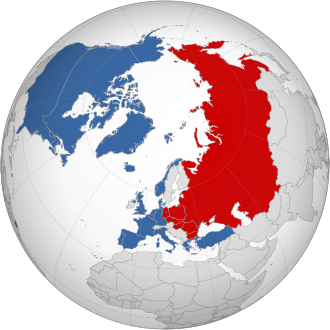
The Cold War was a period of international geopolitical rivalry between the United States (US) and the Soviet Union (USSR) and their respective allies, the capitalist Western Bloc and communist Eastern Bloc. It began in the aftermath of the Second World War and ended with the dissolution of the Soviet Union in 1991. The term cold war is used because there was no direct fighting between the two sup

Popular Shayari

62 total
Quote
"You know, I thought that when we ended the Cold War, one of the most profound, I would say, principles was one that President Gorbachev, then the president of the Soviet Union, expounded. He said, you know, security must be security for all. And that was precisely how he justified reduction in the Soviet military. And even before the Soviet Union broke up, we were living in peace, and we had a united Europe. Many people seem to feel that the breakup of the Soviet Union was the end of the Cold War. That’s wrong. It had ended two years before that. And the breakup of the Soviet Union did not occur because of Western pressure; it occurred because of internal pressures within the Soviet Union. And it was something that President Bush did not wish. As a matter of fact, one of his last speeches, when there was a Soviet Union, was in Kyiv, when he advised Ukrainians to join Gorbachev’s voluntary federation, that he was proposing, and actually warned against suicidal nationalism. Those words, you know, are not remembered much now. People seem to think that Ukraine is free because of the end of the Cold War and the pressure of the West as one of the fruits of victory in the Cold War. This is simply incorrect. It turns history upside down."
Cold WarCold War
Quote
"Many members of the Washington press, including editors and publishers, had served in the government during the Second World War—in the Office of Strategic Services (the forerunner of the C.I.A.), in the Office of War Information, and in other capacities in Washington and London. They had been part of the war effort, and their sense of duty persisted after the war ended. Defending democracy was not just the government’s job. It was the press’s job, too. When reporters were in possession of information that the American government wanted to keep secret, they therefore asked themselves whether publishing it would damage the Cold War mission. “Fighting for peace remained central to the diplomatic press corps’ conception of its responsibilities,” McGarr says. “Quality reporting meant being an advocate not for the government but for ‘the Peace.’ ” There was another reason for caution: fear of nuclear war. After the Soviets developed an atomic weapon, in 1949, and until the Test Ban Treaty of 1963, end-of-the-world nuclear anxiety was widespread, and newsmen shared it. The Cold War was a balance-of-power war. That’s what the unofficial doctrine of the American government, “containment,” meant: keep things as they are. Whatever tipped the scale in the wrong direction might unleash the bomb, and so newspapers were careful about what they published."
Cold WarCold War
Quote
"In the Soviet Union the fear that the West was about to unleash a hot war was growing. The installation of the Reagan regime and its inflammatory rhetoric had so concerned the Soviets that at a session of the KGB high command and senior staff, General Secretary Leonid Brezhnev and KGB chief Yuri Andropov stated that the United States was actively preparing for a nuclear attack on the USSR. It was announced internally that the KGB and Soviet military intelligence would mount a new intelligence collection operation aimed at monitoring nuclear preparedness and to warn of U.S. nuclear war preparations. The intelligence alert sought information on key U.S./NATO political and strategic decisions about the USSR and the Warsaw Treaty Organization; early warning of U.S./ NATO preparations for launching a surprise nuclear attack; and new U.S./NATO weapons systems intended for use in a surprise nuclear attack. Code named Operation RYaN for raketno-yadernoye napadenie, or nuclear-rocket attack, agents spread across Europe and the rest of the world in search of the signs of an impending U.S. attack on the Soviet Union."
Cold WarCold War
Quote
"The globalization of the Cold War took place in the course of the 1950s. In its geopolitical aspect, this was the natural outcome of a confrontation that pitted one power which dominated the land mass of Eurasia against another which could project land, sea, and air forces to all parts of the world. In its political, economic, and ideological aspects it reflected the rivalry of one bloc with pretensions to the worldwide patronage of communist-led revolution and another wedded to democracy, capitalism, and free trade."
Cold WarCold War
Quote
"At the end of the year people finally got a glimpse of what the United States and NATO had planned for the Pershing and cruise missiles. NATO selectively released parts of a target planning document which said that NATO had "more than 2,500 high-priority targets, about two-thirds are located in the non Soviet-Warsaw Pact and the remaining one-third in the Soviet Union." It also noted that the twenty-five-hundred-kilometre-range ground-launched cruise missile based in the United Kingdom could strike "approximately 87% of the high-priority targets, including Moscow itself."
Cold WarCold War
Quote
"Israel has fought one battle after another, clinging to survival in the decades after its people were systematically murdered during the Holocaust. But the story of self-determination and Arab-Israeli conflicts spills out far beyond the borders of the Middle East. Israel wasn’t just the site of regional disputes—it was a Cold War satellite, wrapped up in the interests of the Soviets and the Americans. The U.S.S.R. started exerting regional influence in a meaningful way in 1955, when it began supplying Egypt with military equipment. The next year, Britain and the U.S. withdrew financing for Egypt’s Aswan High Dam project over the country’s ties with the U.S.S.R. That move triggered the Suez Crisis of 1956, in which Egypt, with the support of the USSR, nationalized the Suez Canal, which had previously been controlled by French and British interests."
Cold WarCold War
Quote
"During the Cold War a new conceptual framework took hold of U.S. defense thinking in an attempt to reduce unpredictability. The advent of the computer and its incorporation into the military as a data processor and numbers cruncher during World War II led commanders to believe that the uncertainty and unpredictability that defined chaos on the battlefield could be overcome through information technology. Chaos was seen as an information deficiency rather than an inescapable element of warfare. Massive amounts of data were collected and processed in an attempt to reach battlefield clarity and subordinate the theatre of war. The new term "command and control" described the belief that commanders could issue orders, receive new information through feedback of their technology system and adjust subsequent orders accordingly."
Cold WarCold War
Quote
"During the period 1973–1983, armour production in the Soviet Union amounted to approximately 3,000 main battle tanks a year. By the late 1970s, the Warsaw Pact had 10,000 more tanks than NATO in Central Europe. Lessons learned from the performance of the Egyptian Army during the early phases of the 1973 Yom Kippur War taught the Soviet Army the advantages in a war of deploying anti-tank guided missiles (ATGMs) to counter NATO armoured counter-attacks. The proliferation of ATGMs with NATO forces in the late 1970s eventually drove the Soviet Army to protect its tanks with ‘explosive reactive armour’, rendering them in many cases invulnerable to antitank hits."
Cold WarCold War
Quote
"Suspicions and fears of others, from rival gangs to countries, can create perceptions of threats even where they might not exist, just as they do for our cousins the chimpanzees. During the Cold War the mutual mistrust of the West and the Soviet bloc meant that each tended to interpret words and actions by the other, even accidents, in the most unfavourable light. A bear trying to climb a fence around an American missile was mistaken for enemy intruders, flocks of birds appeared on American and Canadian radar to be planes or missiles, or the sun glinting off clouds looked like an incoming attack to Soviet technicians, and the Third World War, briefly, came much closer. Once an American technician put a training tape into a computer at the North American Air Defense Command by mistake and suddenly command centres got warnings that Soviet missiles were heading in. Bomber crews went to their planes and American missiles were put on heightened alert. Fortunately the mistake was discovered in time. In 1983, after it had accidentally shot down the Korean airliner KAL007, the Soviet Union wove together unrelated coincidences – NATO training exercises, for example, and an increase in encrypted communications between Prime Minister Margaret Thatcher and President Ronald Reagan – to construct a scenario of an imminent nuclear attack."
Cold WarCold War

Similar Authors & Thinkers



