SHAWORDS
Cougars

Cougars

Cougars

Cougars

author
7Quotes

The cougar, also called puma, mountain lion, catamount, and panther, is a large small cat native to the Americas. It inhabits North, Central and South America, making it the most widely distributed wild, terrestrial mammal in the Western Hemisphere, and one of the most widespread in the world. Its range spans Yukon, British Columbia and Alberta in Canada, the Rocky Mountains and areas in the weste

Popular Quotes

7 total
Quote
"After a stalk of a few minutes across a , puma crouched behind bush and waited until nearest deer came within 5 ft. Puma caught its hindquarters with its front paws probably because tall brush prevented a leap. The deer was forced to its haunches and after struggling downhill for about 70 ft. stumbled; and deer and puma rolled over and over out of sight into clump of shrubs where it was killed. Puma carried deer for about 50 yds., dragged it at least another 80 yds. Liver eaten and uneaten stomach and intestines removed from hole in deers side next to ribs. Buried carcass under leaves and weeds."
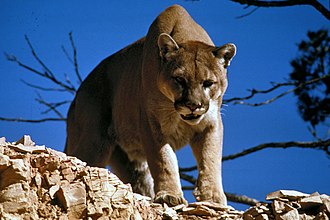
CougarsCougars
Quote
"Mountain lions (Puma concolor) were previously endemic across Pennsylvania. The species was officially declared regionally extinct in 2011 by the , although the last time that a mountain lion was observed east of the was in Maine in 1938, excluding the current population that resides in Florida. The Northeastern population of P. concolor has been almost nonexistent since the early 1800s, most likely due to targeted hunting depredation by farmers to protect livestock, along with habitat destruction and fragmentation. The last documented observation of P. concolor in Pennsylvania specifically was in 1874."
CougarsCougars
Quote
"... After the near elimination of mountain lions from the United States in the first half of the 20th century, protective laws beginning in the mid-1960s allowed them to reestablish or increase their populations across the West. Mountain lions typically occur in topographically varied s. Their rugged habitat is one of the main reasons that lions are seldom seen. They live in areas with high prey densities and enough vegetation and topography for good hunting cover. Maternal females usually select dens in rock outcrops, dense shrubs, or under conifers well out of sight of people."
CougarsCougars
Quote
"Puma concolor, a large American cat species, occupies the most extensive range of any New World terrestrial mammal, spanning 100 degrees of latitude from the to the . ... Genomic DNA specimens from 315 pumas of specified geographic origin (261 contemporary and 54 museum specimens) were collected for molecular genetic and phylogenetic analyses of three mitochondrial gene sequences (16S rRNA, ATPase-8, and NADH-5) plus composite microsatellite genotypes (10 feline loci). ... The marked uniformity of mtDNA and a reduction in microsatellite allele size expansion indicates that North American pumas derive from a recent ( circa 10,000 years ago) replacement and recolonization by a small number of founders who themselves originated from a centrum of puma genetic diversity in eastern South America 200,000-300,000 years ago. The recolonization of North American pumas was coincident with a massive late Pleistocene extinction event that eliminated 80% of large vertebrates in North America and may have extirpated pumas from that continent as well."
CougarsCougars

Similar Authors & Thinkers



