Quote
"We [the Futurists] must smash, demolish and destroy our traditional harmony, which makes us fall into a gracefullness created by timid and sentimental cubs [this denigrating word refers to the French Cubists]."
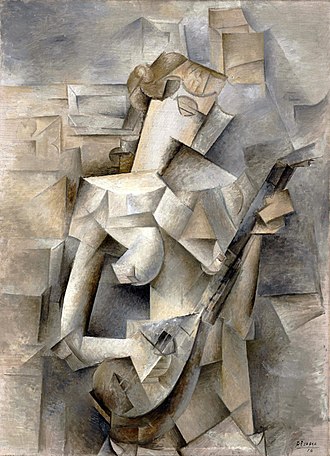 Cubism
Cubism
Cubism
Cubism is an early-20th-century avant-garde art movement which began in Paris. It revolutionized painting and the visual arts, and sparked artistic innovations in music, ballet, literature, and architecture.
"We [the Futurists] must smash, demolish and destroy our traditional harmony, which makes us fall into a gracefullness created by timid and sentimental cubs [this denigrating word refers to the French Cubists]."
Cubism"Scientific Cubism is one of the pure tendencies. It is the art of painting new compositions with elements taken not from reality as it is seen, but reality as it is known. The painters associated with this are Picasso (whose art also belongs to the other pure Cubist tendency), Georges Braque, Metzinger, Albert Gleizes, Mademoiselle Laurencin and Juan Gris ̧"
Cubism"..Is it indisputable that several aesthetic declarations of our French comrades [the Cubists in Paris] display a sort of masked academicism. It is not, indeed, a return to the Academy to declare that the subject, in painting, has a perfectly insignificant value?.. .To paint from the posing model as an absurdity, and an act of mental cowardice, even if the model be translated upon the picture in linear, spherical and cubic forms.."
Cubism"[the Cubist painters who].. continued to paint objects motionless, frozen, and all the static aspects of Nature; they worship the traditionalism of w:Poussin, of w:Ingres, of Corot, ageing and petrifying their art with an obstinate attachment to the past, which to our eyes remains totally incomprehensible."
Cubism"This is the way in which the artist [in Russian Constructivism (art|Constructivism]] ] has set about the construction of the world - an activity which affects every human being and carries work beyond the frontiers of comprehension. We see how its creative path took it by way of Cubism to pure construction, but there was still no outlet to be found here."
Cubism"Already, a conscious courage is coming to life. Here are some of the painters: Picasso, Braque, Delaunay, Le Fauconnier.. ..they are highly enlightened, and do not believe in the stability of any system, even if it were to call itself classical art.. ..Their reason is poised between the pursuit of the fleeting and a mania for the eternal."
Cubism"Neo-Plasticism [= De Stijl] has its roots in Cubism. It could just as easy be called the Painting of Real Abstraction. Since the abstract can be expressed by a plastic reality.. .It achieves what all painting has tried to achieve but has been able to express only in a veiled manner. By their position and their dimension as well as by the importance of given to colour, the coloured planes express in a plastic way only relations and not forms. Neo-Plasticism imparts to these relations an aesthetic balance and thereby expresses universal harmony [quote in 1921-23]."
Cubism"Cubism is not a formula, it is not a school. Cubism is a philosophy, a point of view in the universe. It is like standing at a certain point on a mountain and looking around. If you go higher, things will look different; if you go lower, again they will look different. It is a point of view."
Cubism"Futurism and Cubism are comparable in importance to the invention of perspective, for which they substituted a new concept op space. All subsequent movements were latent in them or brought about by them.. ..the two movements cannot be regarded as in opposition to each other, even though they started from opposite points; I maintain [an idea approved by Apollinaire and later by Matisse,] that they are two extremes of the same sign, tending to coincide at certain points which only the poetic instinct of the painter can discover: poetry being the content and raison dêtre of art."
Cubism"The intellectual abstraction of the second [analytical] period of Cubism was of great importance, however. By its aspirations to the eternal and its concept of proportion inspired by the Classics it revived the sense of craftsmanship concept in many painters. And this perfectly coincided with another of my ambitions – which was to make, with paint, an object having the same perfection of craftsmanship that a cabinet-maker would put into a piece of furniture."
Cubism"I couldnt portray a women in all her natural loveliness.. .I havent the skill. No one has. I must, therefore, create a new sort of beauty, the beauty that appears to me in terms of volume of line, of mass, of weight, and through that beauty interpret my subjective impression. Nature is mere a pretext for decorative composition, plus sentiment. It suggests emotion, and I translate that emotion into art. I want to express the absolute, not merely the factitious woman."
Cubism"One must have lived those years between 1907 and 1914 with them [ Braque, Picasso and the younger Juan Gris ] in order to understand the meaning of a collective effort by a number of great painters, in order to understand anything of the continual exchange of [artist] ideas."
Cubism




