Quote
"I will obey the god rather than you, and as long as I draw breath and am able, I shall not cease to practice philosophy."
 Deity
DeityDeity
Deity
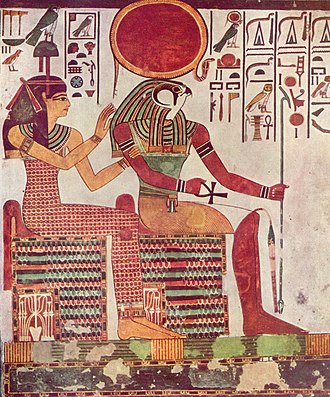
A deity or god is a supernatural being considered to have authority over some aspect of the universe and/or life, with many also being considered as sacred and worthy of worship. The Oxford Dictionary of English defines deity as a god or goddess, or anything revered as divine. C. Scott Littleton defines a deity as "a being with powers greater than those of ordinary humans, but who interacts with h
"I will obey the god rather than you, and as long as I draw breath and am able, I shall not cease to practice philosophy."
Deity"Nevertheless they could never be imagined save in the most radiant bloom of youth. For the Hellenic idea of god this is very significant and serves as a symbol of their peculiar essence. Other peoples have felt no compunction in thinking of their deity as old, indeed as very ancient; no image could more forcefully suggest the venerable wisdom they possessed. But for the Greek his inmost feelings resisted such a notion. For him old age was a condition of the weariness, impoverishment, and darkening of nature, that vital and holy nature from which he could never at all separate the spirit. Even the highest wisdom must belong not to a region beyond life but to lifes most buoyant energy, and knowledge must dwell not on the hoary countenance turned away from the world but on the bright and youthful brow and the blooming lips of Apollo."
Deity"Junctæque Nymphis Gratiæ decentes."
Deity"Between the gods of light and darkness, of Order and Chaos, Elric knew there was little to choose. The capricious nature of immortality and omniscience played little part in the way of character-building. Too much time—and too little with which to fill it—made the Great Ones no less obstreperous and objectionable than a spoiled tavern brat with a bellyfull of cheap ale and an itchy sword-hand. Thus, just as he would strive to avert his gaze from the local folk in the numerous hostelries he came upon during his travels, so, too, did he rarely look into the sky, the distant plateaus beyond which the gods lazed, their milky eyes scouring the land below for any potential amusements."
Deity"Vilia miretur vulgus; mihi flavus Apollo Pocula Castalia plena ministret aqua."
Deity"August Nibru! No deity excels like your lord and lady! They are powerful princes; they are brilliantly revealed deities. No deity excels like Enlil or Ninlil!"
Deity"The god we now behold with opened eyes, A herd of spotted panthers round him lies In glaring forms; the grapy clusters spread On his fair brows, and dangle on his head."
Deity"And now I will try to defend myself against them: these new accusers must also have their affidavit read. What do they say? Something of this sort: — That Socrates is a doer of evil, and corrupter of the youth, and he does not believe in the gods of the state, and has other new divinities of his own."
Deity"Speak of the gods as they are."
Deity"A glimpse of Breidablick, whose walls are light As een the silver on the cliff it shone; Of dark blue steel its columns azure height And the big altar was one agate stone. It seemed as if the air upheld alone Its dome, unless supporting spirits bore it, Studded with stars Odins spangled throne, A light inscrutable burned fiercely oer it; In sky-blue mantles, Sat the gold-crowned gods before it."
Deity"Creator Venus, genial power of love, The bliss of men below, and gods above! Beneath the sliding sun thou runnst thy race, Dost fairest shine, and best become thy place; For thee the winds their eastern blasts forbear, Thy mouth reveals the spring, and opens all the year; Thee, goddess, thee, the storms of winter fly, Earth smiles with flowers renewing, laughs the sky."
Deity"With ravishd ears The monarch hears, Assumes the god, Affects to nod, And seems to shake the spheres."
Deity




