Quote
"Quite a few of us get pissed with liver crippling draughts of prison hooch, that last vestige of herbal medicine still available to cons."
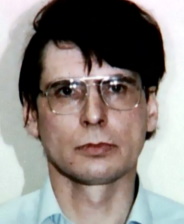 Dennis Nilsen
Dennis Nilsen
Dennis Nilsen
Dennis Andrew Nilsen was a Scottish serial killer and necrophile who murdered at least twelve young men and boys between 1978 and 1983. Convicted at the Old Bailey of six counts of murder and two of attempted murder, Nilsen was sentenced to life imprisonment on 4 November 1983, with a recommendation that he serve a minimum of 25 years; this recommendation was later changed to a whole life tariff i
"Quite a few of us get pissed with liver crippling draughts of prison hooch, that last vestige of herbal medicine still available to cons."
Dennis Nilsen"Hes nothing. Hes a liar. Hes taken human lives. I feel sorry for his mother, to give birth to such a monster."
Dennis Nilsen"No-one but Nilsens lawyer and one or two close confidantes have read [his autobiography] (its not published dont forget) so who the hell can say whether it "glorifies his crimes" or not? And even if it does, and thats honestly how he feels towards his actions, isnt that extremely interesting? Shouldnt the public and psychiatrists and forensic psychologists and criminal profilers be grateful for such a first-hand account and unashamed glorying of such a crime? To me such a book would be extremely useful and insightful to many people. So whether it glorifies the crimes or tries to explain them I think the book has every right to be published, and I think its in the public interest to do so. For the argument that "it’s not in the victims interest to do so” well, I dont believe thats true, but even if it were, I dont think a handful of bitter people (bitter for very good reason) should decide the fate of the nation. If the books published the victims have every right not to read it and the public has every right to boycott it, but it MUST be available. As my mother recently said: Why the fuck should he have his book published! Though yeah, if it were published Id probably read it."
Dennis Nilsen"The devil makes work for idle thirsts. But given the choice between booze and cannabis, I go for ganja every time."
Dennis Nilsen"I could only relate to a dead image of the person I could love. The image of my dead grandfather would be the model of him at his most striking in my mind. It seems necessary for them to have been dead in order that I could express those feelings which were the feelings I held sacred for my grandfather ... it was a pseudo-sexual, infantile love which had not yet developed and matured. The sight of them [my victims] brought me a bitter sweetness and a temporary peace and fulfillment."
Dennis Nilsen"In those days I could hate Adam Scott very easily. I was, I suppose, very jealous of him having a relationship with and the attention of my mother. I sometimes felt that we, the Nilsen kids, were an impediment to her fulfillment in her new life and family. I was a very lonely and turbulent child. I inhabited my own secret world full of ideal and imaginary friends. Nature had mismatched me from the flock."
Dennis Nilsen"Being a loner has its advantages, a self-containment necessary for keeping body and soul alive and progressing. Dying in prison is not such a great problem as living in prison."
Dennis Nilsen"My troubles started there. It blighted my personality permanently. I have spent all my emotional life searching for my grandfather and in my formative years no one was there to take his place. It is the custom up there in Fraserburgh that when there is a death in a household they draw the blinds and curtains. When my grandfather died it seemed that these blinds had been drawn across my life... Relatives would pretend that he had gone to a better place. Why, I thought, should he go to a better place and not take me with him? So death was a nice thing, I thought. Then why does it make me miserable?"
Dennis Nilsen"I eased him into his new bed [beneath the floorboards] ... A week later, I wondered whether his body had changed at all or had started to decompose. I disinterred him and pulled the dirt-stained youth up onto the floor. His skin was very dirty. I stripped myself naked and carried him into the bathroom and washed the body. There was practically no discoloration and his skin was pale white. His limbs were more relaxed than when I had put him down there."
Dennis Nilsen"[To] call Nilsen a monster is to avoid the issue. People identified as witches were once burned without further ado, it being simpler to get rid of them than to examine the questions which their alleged conduct, and societys hysterical reactions to it, raised. Nilsen has done monstrous things, and the responsible attitude would be to study his personality probingly in the hope of finding out why. Not for his sake, to give him the chance of redemption, but for ours, to deepen our knowledge and improve the chances of detecting such an aberrant personality before it does harm and causes grief. If the death penalty were still in force, it would be idiotic to kill Nilsen, for that would be to destroy the only evidence worth exploring."
Dennis Nilsen"I would say that he wanted the bodies to be there because it assured him how in control he was of other people. This is what is arousing to an individual like Nilsen; to be in complete control and domination of others."
Dennis Nilsen"It is frustrating to be translating other peoples autobiographies whilst mine is lying unpublished, banned by the Home Office."
Dennis Nilsen




