Quote
"The Salvadoran military has shown really professional standing. I dont see them playing the old game."
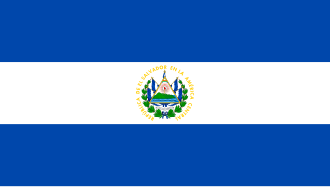 El Salvador
El Salvador
El Salvador
El Salvador, officially the Republic of El Salvador, is a country in Central America. It is bordered on the northeast by Honduras, on the northwest by Guatemala, and on the south by the Pacific Ocean. El Salvador's capital and largest city is San Salvador. El Salvador's population in 2024 was estimated to be 6 million.
"The Salvadoran military has shown really professional standing. I dont see them playing the old game."
El Salvador"The persistence into the twentieth century of a specific institutional pattern inimical to growth in Mexico and Latin America is well illustrated by the fact that, just as in the nineteenth century, the pattern generated economic stagnation and political instability, civil wars and coups, as groups struggled for the benefits of power. Díaz finally lost power to revolutionary forces in 1910. The Mexican Revolution was followed by others in Bolivia in 1952, Cuba in 1959, and Nicaragua in 1979. Meanwhile, sustained civil wars raged in Colombia, El Salvador, Guatemala, and Peru. Expropriation or the threat of expropriation of assets continued apace, with mass agrarian reforms (or attempted reforms) in Bolivia, Brazil, Chile, Colombia, Guatemala, Peru, and Venezuela. Revolutions, expropriations, and political instability came along with military governments and various types of dictatorships. Though there was also a gradual drift toward greater political rights, it was only in the 1990s that most Latin American countries became democracies, and even then they remain mired in instability."
El Salvador"The men and women of El Salvador are the ones who decide, and if you dont accept the result, you are violating the will of the people."
El Salvador"The real lesson of Romero is that there are no legitimate reasons to deny [civil] rights. His government in his time believed that [civil] rights could be somewhat “suspended” to protect El Salvador from Communist influences coming from the Soviet Union via Cuba and Nicaragua. Romero was certainly not an admirer of the Soviet Union, but believed there should be other ways of protecting his country, not suspending [civil] rights. He taught us that those who advocate for [civil or natural] rights are “for” their countries, not “against” them."
El Salvador




