Quote
"Making art has first of all to do with honesty. My first lesson was to see objectively, to erase all meaning of the thing seen. Then only, could the real meaning of it be understood and felt."
E
Ellsworth KellyEllsworth Kelly
Ellsworth Kelly
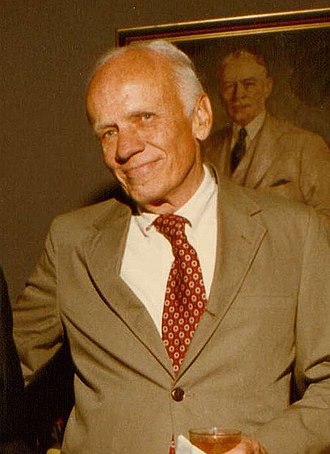
Ellsworth Kelly was an American painter, sculptor, and printmaker associated with hard-edge painting, Color field painting and minimalism. His works demonstrate unassuming techniques emphasizing line, color and form, similar to the work of John McLaughlin and Kenneth Noland. Kelly often employed bright colors. He lived and worked in Spencertown, New York.
"Making art has first of all to do with honesty. My first lesson was to see objectively, to erase all meaning of the thing seen. Then only, could the real meaning of it be understood and felt."
"When I want to do a painting with one colour overlapping another, it has to be a real overlap, not a depicted overlap. I didnt want to paint an overlap, meaning that it would be a deception or illusion. I no longer wanted to depict space, but to make a work that existed in literal space. Thus, my recent works are one canvas as a relief over another canvas. Another important example of a panel painting that explores the idea of the mural was Red Yellow Blue White 1952. Its the only one I ever did using actual dyed fabric of ready-made colours, which moves the painting into the realm of real objects."
"In Europe at the beginning of the twentieth century, the Fauves – Matisse, Derain – were using bright colours in their full intensity, which continued with Kandinsky, Malevich, Kirchner, Léger and Mondrian. They employed all the colours of the spectrum. In the 1940s and 1950s the majority of the Abstract Expressionists in New York rebelled against this European use of colour and mostly used mixed colours. That is, the Abstract Expressionists did use bright colours sometimes, but they tended to paint wet-on-wet, which muddled their hues. As Matisse would say, a small patch of any one colour is far less intense than a large one of the same colour. I returned in 1954 [from Paris] to New York and showed paintings done in France at the Betty Parsons Gallery in 1956 with bright colours that wouldn’t really be used until the Pop artists in the 1960s. My idea of using colour at its full intensity, which began with Colors for a Large Wall, hasn’t changed in the 60 years that I’ve been painting."
"I felt that everything is beautiful, but [not?] that which man tries intentionally to make beautiful; that the work of an ordinary bricklayer is more valid than the artwork of all but a very few artists."
"Like the postcard collages, the colors are shapes in a landscape. In this case [his collage Napoleon at Würtsburg] it is a painting of a landscape, not a photo as in the postcards [collages], and therefore a contrast of the traditional painting and a presentation of literal space on top of depicted space."
"Instead of making a picture that was an interpretation of a thing seen, or a picture of invented content, I found an object and presented it as itself alone. My first object was Window [Museum of Modern Art, Paris], done in 1949. After constructed Window with two canvases and a wood frame I realized that from then on painting as I had known it was finished for me. The new works were to be objects, unsigned, anonymous."
"Soon after completing the La Combe series [circa 1950] I had a dream in which I was assisted by many children on a scaffold, painting a huge mural made up of square panels fitted together. Each panel was being painted by a child very quickly in long black strokes with huge brushes. The work was done in seconds. Upon waking I immediately made a reminder sketch of the mural. Later I made a drawing of many ink strokes, which I cut up into twenty squares and placed at random in a four-by-five grid.."
"Simple, I dont like the word simple. I like easy better. I want to forget about the technique. I sweat and worry but I dont want it look like that; but you can’t separate the artist and his technique."
"My collages are only ideas for things much larger – things to cover walls. In fact all the things that I have done I would like to see much larger. I am not interested in painting as it has been accepted for so long – to hang on walls of houses as pictures. To hell with pictures – they should be the wall – even better – on the outside wall – of large buildings. Or stood up outside as billboards or a kind of modern icon. We must make our art like the Egyptians, the Chinese & the African and the Island primitives – with their relation to life. It should meet the eye direct."
"This book [full of linoleum prints] will be an alphabet of pictorial elements without text, which shall aim at establishing a larger scale of painting, a closer contact between the artist and the wall, and a new spirit of art accompanying architecture."
"Im interested in the mass and color, the black and the white, the edges happen because the forms get as quiet as they can be."
"In my painting, negative space is never arbitrary. (I believe lithographs to be colored marks printed on a ground – the paper and the measure of the ground and the marks are to be considered of equal importance). In my painting, the painting is the subject rather than the subject the painting."