SHAWORDS
EPR paradox

EPR paradox

EPR paradox

EPR paradox

author
22Quotes

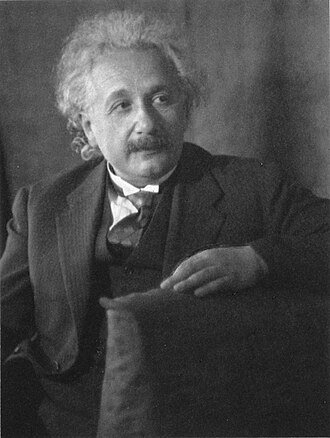
The Einstein–Podolsky–Rosen (EPR) paradox is a thought experiment proposed by physicists Albert Einstein, Boris Podolsky and Nathan Rosen, which argues that the description of physical reality provided by quantum mechanics is incomplete. In a 1935 paper titled "Can Quantum-Mechanical Description of Physical Reality be Considered Complete?", they argued for the existence of "elements of reality" th

Popular Quotes

22 total
Quote
"Many years ago David Bohm proposed replacing the hypothetical "completeness" experiment of Einstein, Podolsky, and Rosen...by a modified and more practical version. Bohms experiment (called the EPRB...) involves the decay of a particle into two photons... the photons travel in opposite directions, have equal energy, and have identical polarizations. ...John Bell revealed that the EPRB... could be used to distinguish quantum mechanics from hypothetical hidden variable theories. Bells theorem (also called Bells inequalities) concerns a particular quantity that specifies the correlation between the polarizations of the two photons."
EPR paradoxEPR paradox
Quote
"Aage Bohr expressed the same point to me the last time I talked to him. He just couldn’t understand why there were all these conferences—conference after conference—on EPR, when it is just the way it works. It is just exactly the wrong thing to be asking about. There is a conference coming up in Finland in August with some people I’d love to talk to, but I’ve written them to say that I’m not going. If you keep trying to pull apples off the apple tree, after a while it doesn’t do. I hope that I am not being too propagandistic in speaking of the idea that when we see it all it will be so simple we’ll all say, ‘How stupid we’ve been all this time!’ We’ve got to look for the right word, the right image. So you try one word for a day, for a week, for a month, or for a year, and then you give it up and try another one."
EPR paradoxEPR paradox
Quote
"While Einsteins belief in an objective reality is similar to that of Weinberg and Sokal, his arguments for his conception of reality are not. In fact, Einstein was no "naive realist," despite such caricaturing of his stand by the Copenhagen orthodoxy. He ridiculed the "correspondence" view of reality that many scientists accept uncritically. Einstein fully realized that the world is not presented to us twice-first as it is, and second, as it is theoretically described-so we can compare our theoretical "copy" with the "real thing." The world is given to us only once - through our best scientific theories. So Einstein deemed it necessary to ground his concept of objective reality in the invariant characteristics of our best scientific theories."
EPR paradoxEPR paradox
Quote
"It deals with an imaginary experiment, but like so many other works of the imagination this one has surpassed the intentions of its creators. In the first place, it is unlikely that they thought that the experiment they were proposing, or any facsimile, would ever be carried out. This, thanks largely to the work inspired by Bell, has now happened. Indeed, our physics journals are now resplendent with new and ever more ingenious versions of the Einstein-Podolsky-Rosen experiment, along with increasingly accurate experimental results. In the second place, and this is also an aftermath of Bell’s work, the Einstein-Podolsky-Rosen experiment has made its way into much of the popular folklore about the quantum theory. (It is usually referred to in the literature, familiarly, as the EPR experiment.)"
EPR paradoxEPR paradox
Quote
"Einstein had drawn attention to nonlocality in 1935 in an effort to show that quantum mechanics must be flawed. ...Einstein proposed a thought experiment—now called the EPR experiment—involving two particles that spring from a common source and fly in opposite directions. According to the standard model of quantum mechanics, neither particle has a definite position or momentum before it is measured; but by measuring the momentum of one particle, the physicist instantaneously forces the other particle to assume a fixed position... Deriding this effect as "spooky action at a distance," Einstein argued that it violated both common sense and his own theory of special relativity, which prohibits the propagation of effects faster than the speed of light; quantum mechanics must therefore be an incomplete theory. In 1980, however, a group of French physicists carried out a version of the EPR experiment and showed that it did indeed give rise to spooky action. (The reason that the experiment does not violate special relativity is that one cannot exploit nonlocality to transmit information.)"
EPR paradoxEPR paradox
Quote
"The usual conclusion... in quantum mechanics is that when the momentum of a particle is known, its coordinate has no physical reality. More generally, it is shown in quantum mechanics that, if the operators corresponding to two physical quantities... do not commute... then the precise knowledge of one of them precludes such knowledge of the other. Furthermore, any attempt to determine the latter experimentally will alter the state of the system in such a way as to destroy the knowledge of the first. From this follows that either (1) the quantum mechanical description of reality given by the wave function is not complete or (2) when the operators corresponding to the two physical quantities do not commute the two quantities cannot have simultaneous reality."
EPR paradoxEPR paradox

Similar Authors & Thinkers



