SHAWORDS
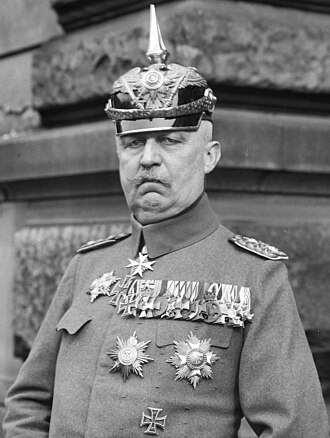
Erich Ludendorff

Erich Ludendorff

Erich Ludendorff

Erich Ludendorff

author1914–1918
13Quotes

Erich Friedrich Wilhelm Ludendorff was a Prussian-born German general and politician. He achieved fame during World War I (1914–1918) for his central role in the German victories at Liège and Tannenberg in 1914. After his appointment as First Quartermaster General of the Great General Staff in 1916, Ludendorff oversaw virtually all decisions regarding Germany's strategy and war effort until the co

Popular Quotes

13 total
Quote
"Why did German soldiers, who had hitherto been so reluctant to give themselves up, suddenly begin to surrender in their tens of thousands in August 1918? The best explanation - again following Clausewitz - is that there was a collapse of morale. This was primarily due to the realization among both officers and men that the war could not be won. General Erich Ludendorffs spring offensives had worked tactically but failed strategically, and in the process had cost the Germans dear, whereas the Allied offensive of August 7-8 outside Amiens was, as Ludendorff admitted, the greatest defeat the German Army has suffered since the beginning of the war. Unrestricted submarine warfare had failed to bring Britain to her knees; occupation of Russian territory after Brest-Litovsk was wasting scarce manpower; Germanys allies were beginning to crumble; the Americans were massing in France, inexperienced but well fed and numerous; perhaps most importantly, the British Expeditionary Force had finally learned to combine infantry, artillery, armour and air operations. Simply in terms of numbers of tanks and trucks, the Germans were by now at a hopeless disadvantage in the war of movement they had initiated in the spring. A German victory was now impossible, and it was the rapid spread of this view down through the ranks that turned nonvictory into defeat, rather than the draw Ludendorff appears to have had in mind. In this light, the mass surrenders described above were only part of a general crisis of morale, which also manifested itself in sickness, indiscipline and desertion."
Erich LudendorffErich Ludendorff
Quote
"The fifth act of the great drama in Flanders opened on the 22nd October. Enormous masses of ammunition, such as the human mind had never imagined before the war, were hurled upon the bodies of men who passed a miserable existence scattered about in mud-filled shell-holes. The horror of the shell-hole area of Verdun was surpassed. It was no longer life at all. It was mere unspeakable suffering. And through this world of mud the attackers dragged themselves, slowly, but steadily, and in dense masses. Caught in the advanced zone by our hail of fire they often collapsed, and the lonely man in the shell-hole breathed again. Then the mass came on again. Rifle and machine-gun jammed with the mud. Man fought against man, and only too often the mass was successful."
Erich LudendorffErich Ludendorff
Quote
"In all the major combatant nations, there was a change of leadership in the middle years of the war, reflecting a perceived need for greater energy and ruthlessness in mobilizing the nation and its resources. In France, Clemenceau came to power, Britain Lloyd George. In Germany, characteristically, it was not a radical civilian politician, but the two most successful generals, Hindenburg and Ludendorff, who took over the reins of power in 1916. The Hindenburg Programme attempted to galvanize and reorganize the German economy to bend it to the overriding purpose of winning the war. Run by another middle-class general, Wilhelm Groener, the War Office co-opted the trade unions and civilian politicians in the task of mobilization. But this was anathema to the industrialists and the other generals. Groener was soon dispensed with."
Erich LudendorffErich Ludendorff

Similar Authors & Thinkers