Quote
"Good afternoon. Bonjour, Canada. I must tell you, I took 4 years of French in school. First time I attempted to make a speech in French, I was laughed at. So thats as good as I can get right now."
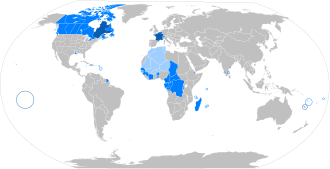 French language
French language
French language
French language is a Romance language of the Indo-European family. Like all other Romance languages, it descended from the Vulgar Latin of the Roman Empire. French evolved from Northern Old Gallo-Romance, a descendant of the Latin spoken in Northern Gaul. Its closest relatives are the other langues d'oïl—languages historically spoken in northern France and in southern Belgium, which French (Franci
"Good afternoon. Bonjour, Canada. I must tell you, I took 4 years of French in school. First time I attempted to make a speech in French, I was laughed at. So thats as good as I can get right now."
French language"Ce qui nest pas clair nest pas français."
French language"With respect to modern languages, French, as I have before observed, is indispensible [sic]. Next to this the Spanish is most important to an American. Our connection with Spain is already important and will become daily more so. Besides this the antient part of American history is written chiefly in Spanish."
French language"I include in my salutation my Canadian friends who speak the French language. Although I am more than bold to attempt even this slight venture into the speaking of that tongue, I ask your forgiveness for errors both in expression and in pronunciation as I take this means of conveying to you personally and directly my sentiments of friendship and high esteem. Likewise, I salute you for the great contribution you, together with your English-speaking brethren, have made to the growth of this great country."
French language"During this time of great change, Canadians are uniting behind what makes Canada unique. The French language and the Quebec culture are at the heart of the Canadian identity. They define the country that Canadians and I love so much. Canada is a country that respects and celebrates its official languages and Indigenous languages. The government is determined to protect the institutions that bring these cultures and this identity to the world, like CBC/Radio-Canada."
French language"A theorization of what it means to look like a language and sound like a race can be found in the opening chapter of Frantz Fanons Black Skin, White Masks, titled "The Negro and Language": “The problem that we confront in this chapter is this: The Negro of the Antilles will be proportionately Whiter-that is, he will come closer to being a real human being-in direct ratio to his mastery of the French Language.... What we are getting at becomes plain: Mastery of language affords remarkable power.... The Black man who has lived in France for a length of time returns radically changed. To express it in genetic terms, his phenotype undergoes a definitive, an absolute mutation.” (1967:18-19) Fanons evocative description of interactions in the French Caribbean context speaks to the powerful ways that categories of language and race become iconic of one another, such that linguistic practices can shape ones racial ontology."
French language"When King Gustaf III was preparing an attack on Denmark in 1783 he wrote to his chief aide-de-camp, Colonel Toll, that he was extremely busy and needed to write in French rather than in Swedish because it took so much less time. It is true that he was unusually good at French: even Vergennes, who did not like him at all, acknowledged his exceptional command of the French language. But he was not unique. The whole of northern Europe was dominated in the same way by the French language and French culture. Frederick II of Prussia, the Empress Catherine II of Russia, the Emperors Joseph II and Leopold II of Austria, the kings of Denmark and Poland – all of them spoke and wrote French fluently; and some of them, like Catherine II, wrote it in a fine, literary style. King Adolf Fredrik of Sweden and his queen both came from Germany as adults, but their son Gustaf never learned to understand German. French was the language in which he was educated, and Queen Louisa Ulrica insisted in his youth that he should write one letter in French to her every day. Indeed correspondence between members of the royal family was generally carried on in French at this time."
French language




