Quote
"I know its a long shot and people would say its too absurd… but Im doing this with hopes of making a Mickey Mouse some day."
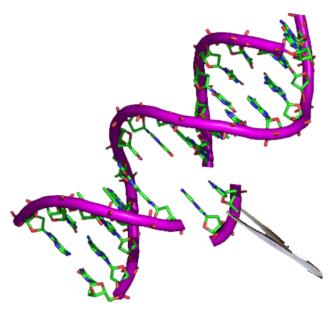 Genetic engineering
Genetic engineering
Genetic engineering
Genetic engineering, also called genetic modification or genetic manipulation, is the modification and manipulation of an organism's genes using technology. It is a set of technologies used to change the genetic makeup of cells, including the transfer of genes within and across species boundaries to produce improved or novel organisms. New DNA is obtained by either isolating and copying the geneti
"I know its a long shot and people would say its too absurd… but Im doing this with hopes of making a Mickey Mouse some day."
Genetic engineering"The genetic material for modification may be either derived from natural organisms using standard recombinant DNA techniques, or produced by DNA synthesis, the latter being much less labor intensive. In recent work, DNA sequences on the order of 1 million base-pairs have been synthesized entirely from digitized genome sequence information, and the resulting organisms were phenotypical and capable of self-replication."
Genetic engineering"I went to Monsasnto, and I spent a lot of time with the scientists there, and I have revised my outlook, and Im very excited about telling the world. When you’re in love, you want to tell the world."
Genetic engineering"By using genetic engineering, biological researchers have already developed new weapons that are much more effective than their natural counterparts. Countless examples from the daily work of molecular biologists could be presented here, not least the introduction of antibiotic resistance into bacterial pathogens, which today is routine work in almost any microbiology laboratory. Indeed, many research projects in basic science show—sometimes unwillingly and unwittingly—how to overcome current scientific and technological limits in the military use of pathogenic agents. Furthermore, genetic engineering is not merely a theoretical possibility for future biowarfare: it has already been applied in past weapons programmes, particularly in the former Soviet Union. One example is the USSRs invisible anthrax, resulting from the introduction of an alien gene into Bacillus anthracis that altered its immunological properties (Pomerantsev et al., 1997). Existing vaccines proved to be ineffective against this new genetically engineered strain."
Genetic engineering"Development of novel (i.e., not known to be naturally-occurring) GMOs exhibiting unique designer characteristics requires substantially greater knowledge and capability. Many industrialized nations have laboratories capable of analyzing which immune response modifier genes in humans and livestock, when inserted into an organism together with pathogenicity (e.g., adherence and invasive) factor, will yield highly infectious pathogenic organisms."
Genetic engineering"When we wrote Ecofeminism we raised the issue of reductionist, mechanistic science and the attitude of mastery over and conquest of nature as an expression of capitalist patriarchy. Today the contest between an ecological and feminist world-view and a worldview shaped by capitalist patriarchy is more intense than ever. This contest is particularly intense in the area of food. GMOs embody the vision of capitalist patriarchy. They perpetuate the idea of ‘master molecules’and mechanistic reductionism long after the life sciences have gone beyond reductionism, and patents on life reflect the capitalist patriarchal illusion of creation. There is no science in viewing DNA as a ‘master molecule’ and genetic engineering as a game of Lego, in which genes are moved around without any impact on the organism or the environment. This is a new pseudo-science that has taken on the status of a religion. Science cannot justify patents on life and seed. Shuffling genes is not making life; living organisms make themselves. Patents on seed mean denying the contributions of millions of years of evolution and thousands of years of farmers’ breeding. One could say that a new religion, a new cosmology, a new creation myth is being put in place, where biotechnology corporations like Monsanto replace Creation as ‘creators’. GMO means ‘God move over’. Stewart Brand has actually said ‘We are as gods and we had better get used to it.’"
Genetic engineering"Since the early 1990’s genetically engineered plants have been commercially available. So called “first generation” transgenic plants have been engineered for characteristics that enhance the agricultural yield and marketing. Such characteristics include resistance to pests, herbicides and extreme climates, as well as improved product shelf life. For example, since their first commercial cultivation in 1996, plants have been genetically modified for tolerance to the herbicides glufosinate and glyphosate. A “second generation” of transgenic plants, now in research and development, is aimed at enhancing consumer satisfaction by enhancing taste, texture, or appearance of produce. To date, no second generation transgenic plants are on the market."
Genetic engineering"You can stop splitting the atom; you can stop visiting the moon; you can stop using aerosols; you may even decide not to kill entire populations by the use of a few bombs. But you cannot recall a new form of life."
Genetic engineering"So you did do it. You amalgamated one of Godzillas cells together with the plants cells. Are you proud of this? What kind science do you call this?"
Genetic engineering"When scientists began creating adenoviral vectors in the 1980s, most worked with a particular kind of adenovirus called Ad5, which ubiquitously infects humans and causes the common cold. Researchers stripped Ad5 of the genes it needed to replicate and inserted those genes into genetically engineered cell lines. That ensured that the modified viruses could be grown only in these special cells in the lab. It also opened up space in the Ad5 genome for scientists to stitch in new genes of their choosing. Many scientists hoped to use Ad5 to deliver a human gene that could correct rare genetic mutations—an approach called gene therapy. Those efforts came to a grinding halt in 1999 when a teenage boy with a rare genetic liver disease died after receiving an injection of an Ad5-based gene therapy, which had been designed in James Wilson’s lab at the University of Pennsylvania. The large dose of 38 trillion viruses the patient was given sparked massive body-wide inflammation and sent his immune system into overdrive. After that, scientists mostly stopped using adenoviral vectors for gene therapy, in which the dose needs to be high to reach many cells of the body."
Genetic engineering"Can genetic engineers restore a rapid worldwide rise in grainland productivity? This prospect is not promising simply because plant breeders using traditional techniques have largely exploited the genetic potential for increasing the share of photosynthate that goes into seed. Once this is pushed close to its limit, the remaining options tend to be relatively small, clustering around efforts to raise the plant’s tolerance of various stresses, such as drought or soil salinity. One major option left to scientists is to increase the efficiency of the process of photosynthesis itself—something that has thus far remained beyond their reach."
Genetic engineering"Gene therapy, involving the use of viruses as a vector for introducing generic material into cells, has had some success in treating genetic disorders such as severe combined immunodeficiency, and treatments are being developed for a range of other currently incurable diseases such as cystic fibrosis, sickle cell anemia, and muscular dystrophy. Genes introduced in this manner are not transmitted to the next generation. Gene therapy targeting the reproductive cells—so-called “Germ line Gene Therapy”—at present carries an unquantifiable risk associated with interfering with other genes, hence near-term development and commercialization of this technology is unlikely."
Genetic engineering