Quote
"He is a gentleman; I am a gentlemans daughter; so far we are equal."
 Gentlemen
Gentlemen
Gentlemen
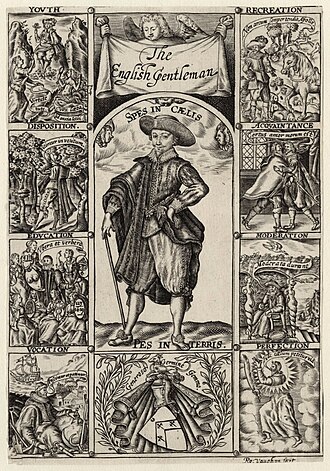
A gentleman is a chivalrous, courteous, or honorable man. Originally, gentleman was the lowest rank of the landed gentry of England, ranking below an esquire and above a yeoman; by definition, the rank of gentleman comprised the younger sons of the younger sons of peers, and the younger sons of a baronet, a knight, and an esquire, in perpetual succession. As such, the connotation of the term gentl
"He is a gentleman; I am a gentlemans daughter; so far we are equal."
Gentlemen"When you leave the little world of Hampden-Sydney, you will still have much to learn of the diversity of the greater world, of the customs and manners of the many cultures you will encounter and interact with as you make your life and living in a global economy. I hope that your recognition of the value of the traditional social customs as they are practiced in our small community will make you keenly aware of the importance of the traditional social customs of other communities- whether ethnic neighborhoods or nations. I end this epilogue as I have ended others before. You are a Hampden-Sydney Gentleman, and as Cardinal Newman wrote, "It is almost the definition of a gentleman to say he is one who never inflicts pain."
Gentlemen"To be a gentleman does not depend upon the tailor, or the toilet.… Good clothes are not good habits.… A gentleman is just a gentle-man; no more, no less: a diamond polished, that was first a diamond in the rough."
Gentlemen"In whatever society he might find himself, the humblest citizen should therefore so order his behaviour that when he left the table men would say "A gentleman was here."
Gentlemen"Oh! St. Patrick was a gentleman, Who came of decent people."
Gentlemen"The Hampden-Sydney ideal of a gentleman reaches back to the 18th century and to the men of the early Republic who defined their lives by honor, service, public virtue, and personal self-restraint. This is what the Colleges Founders meant by "good men and good citizens." To form good men and good citizens is still today the mission of Hampden-Sydney College. However, you will not live in the insular world of Hampden-Sydneys Founders. Your world could not be more different from theirs. It is, however, Hampden-Sydneys belief that the characteristics of the 18th-century gentleman are as important today as two hundred years ago. It is your task to prove it."
Gentlemen"And thus he bore without abuse The grand old name of gentleman, Defamed by every charlatan And soiled with all ignoble use."
Gentlemen"What is it to be a gentleman? Is it to be honest, to be gentle, to be generous, to be brave, to be wise, and, possessing all these qualities, to exercise them in the most graceful outward manner? Ought a gentleman to be a loyal son, a true husband, and honest father? Ought his life to be decent—his bills to be paid—his tastes to be high and elegant—his aims in life lofty and noble?"
Gentlemen"My master hath been an honourable gentleman; tricks he hath had in him, which gentlemen have."
Gentlemen"The taste of beauty, and the relish of what is decent, just and amiable, perfects the character of the gentleman and the philosopher. And the study of such a taste or relish will, as we suppose, be ever the great employment and concern of him who covets as well to be wise and good, as agreeable and polite."
Gentlemen"No one can consider himself a gentleman who engages in the vice of lying."
Gentlemen"Rousseauist and Baconian, though often superficially at odds with one another, have co-operated in undermining, not merely religious tradition, but another tradition which in the Occident goes back finally, not to Judea, but to ancient Greece. This older tradition may be defined as humanistic. The goal of the humanist is poised and proportionate living. This he hopes to accomplish by observing the law of measure. ... Decorum is supreme for the humanist even as humility takes precedence over all other virtues in the eyes of the Christian. Traditionally the idea of decorum has been associated, often with a considerable admixture of mere formalism, with the idea of the gentleman."
Gentlemen




