Quote
"Le cose mal fatte e di gran tempo passate son più agevoli a riprendere che ad emendare."
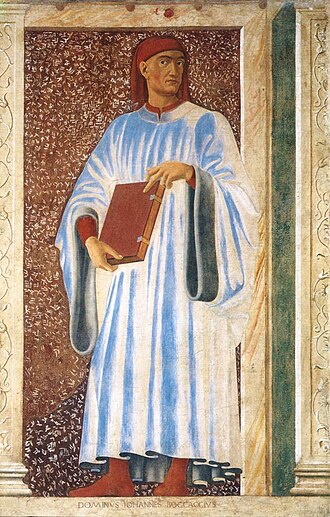 Giovanni Boccaccio
Giovanni Boccaccio
Giovanni Boccaccio
Giovanni Boccaccio was an Italian writer, poet, correspondent of Petrarch, and an important Renaissance humanist. Born in the town of Certaldo, he became so well known as a writer that he was sometimes simply known as "the Certaldese". He was one of the most important figures in the European literary panorama of the fourteenth century. Some scholars define him as the greatest European prose writer
"Le cose mal fatte e di gran tempo passate son più agevoli a riprendere che ad emendare."
Giovanni Boccaccio"Peccato celato e mezzo perdonato."
Giovanni Boccaccio"La gente è più acconcia a credere il male che il bene."
Giovanni Boccaccio"Come la copia delle cose genera fastidio, cosl lesser le desiderate negate moltiplica lappetito."
Giovanni Boccaccio"Natural ragione è di ciascuno che ci nasce, la sua vita, quanto può, aiutare e conservare e difendere."
Giovanni Boccaccio"E poco appresso levatasi la luna, e l tempo essendo chiarissimo, [egli] vegghiava."
Giovanni Boccaccio"Una boccuccia piccolina, le cui labbra parevan due rubinetti."
Giovanni Boccaccio"Chi mal ti vuol, mal ti sogna."
Giovanni Boccaccio"Uno amore...a lieto fin pervenuto, in una novelletta assai piccola intendo di raccontarvi."
Giovanni Boccaccio"Sempre non può l uomo un cibo, ma talvolta desidera di variare."
Giovanni Boccaccio"There are few works which have had an equal influence on literature with the Decameron of Boccaccio. Even in England its effects were powerful. From it Chaucer adopted the notion of the frame in which he has enclosed his tales, and the general manner of his stories, while in some instances, as we have seen, he has merely versified the novels of the Italian. In 1566, William Paynter printed many of Boccaccios stories in English, in his work called the Palace of Pleasure. The first translation contained sixty novels, and it was soon followed by another volume, comprehending thirty-four additional tales. These are the pages of which Shakespeare made so much use. From Burtons Anatomy of Melancholy, we learn that one of the great amusements of our ancestors was reading Boccaccio aloud, an entertainment of which the effects were speedily visible in the literature of the country. The first English translation, however, of the whole Decameron, did not appear till 1620. In France, Boccaccio found early and illustrious imitators. In his own country he brought his native tongue to perfection, and gave stability to a mode of composition, which before his time had only existed in a rude state in Italy; be collected the current tales of the age, which he decorated with new circumstances, and delivered in a style which has no parallel for elegance, naivete, and grace. Hence his popularity was unbounded, and his imitators more numerous than those of any author recorded in the annals of literature."
Giovanni Boccaccio"Se medesimi esaltando con parole da fare per istomacaggine le pietre saltar del muro e fuggirsi."
Giovanni Boccaccio




