Quote
"All they can think of is killing Godzilla. Why dont they try to study its resistance to radiation? This is a once-in-a-lifetime opportunity."
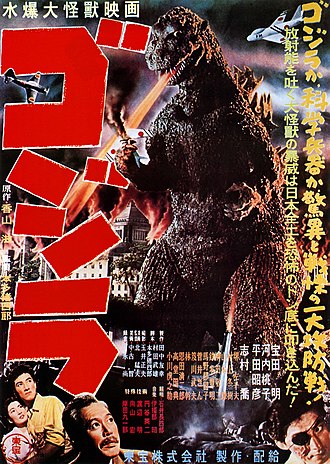 Godzilla (1954 film)
Godzilla (1954 film)
Godzilla (1954 film)
Godzilla is a 1954 Japanese epic kaiju film directed and co-written by Ishirō Honda, with special effects by Eiji Tsuburaya. Produced and distributed by Toho, it is the first film in the Godzilla franchise. The film stars Akira Takarada, Momoko Kōchi, Akihiko Hirata, Takashi Shimura, with Haruo Nakajima and Katsumi Tezuka as Godzilla. In the film, Japanese authorities deal with the sudden appeara
"All they can think of is killing Godzilla. Why dont they try to study its resistance to radiation? This is a once-in-a-lifetime opportunity."
Godzilla (1954 film)"Godzilla" is Mr. Hondas most personal film by far. And you can see the imprint that the war left on him. He worked personally on the script, you know, and he spoke many, many times over the years about how his desire for this film, while it was an entertainment film, by and large, but his desire was to send a message, not an indictment of America, the monster really - thats another difference between "Godzilla" and American monster movies of the same time period. The American monsters usually are stand-ins, as I said, for Cold War enemies. Godzilla is not really a stand-in for America. It is more of an indictment of the nuclear age. And Hondas hope was that somehow this film would inspire people to think about disarmament. I think today if he were still alive, hed be very disappointed that, you know, nuclear weapons are possessed by more nations than ever before."
Godzilla (1954 film)"If used as a weapon, it could lead humanity to exctinction, just like the H-bomb. But Im determined to find a use for the Oxygen Destroyer that will benefit society. Until then, I wont reveal its existence."
Godzilla (1954 film)"Godzilla, both the character and the film, are a reflection on the Japanese experience at the end of World War II: destruction beyond imagining, and a lurking sense that “We brought this on ourselves” somehow, even without meaning to. In the film we see both the guilt, the feeling that the punishment perhaps outweighs the sin, and the striving for redemption, all of which are typical for such stories. In some ways, there’s a similar arc in the origin of Spider-Man: radioactive accidental origin, great power used without regard for consequence (personal profit for Spidey), punishment out of proportion (the death of Uncle Ben), and eventual redemption as a hero."
Godzilla (1954 film)"Godzilla was baptized in the fire of the H-bomb and survived. What could kill it now?"
Godzilla (1954 film)"Ogata...if the Oxygen Destroyer is used even once, the politicians of the world wont stand idly by. Theyll inevitably turn it into a weapon. A-bombs against A-bombs, H-bombs against H-bombs. As a scientist - no, as a human being - adding another terrifying weapon to humanitys arsenal is something I cant allow."
Godzilla (1954 film)"Ogata, men are weak animals. Even if I burn my notes, everything is still in my head. As long as Im alive, who can say I wouldnt be coerced into using it again?"
Godzilla (1954 film)"It was a sober allegory of a film with ambitions as large as its thrice-normal budget, designed to shock and horrify an adult audience. Its roster of frightening images — cities in flames, overstuffed hospitals, irradiated children — would have been all too familiar to cinemagoers for whom memories of Hiroshima and Nagasaki were still less than a decade old, while its script posed deliberately inflammatory questions about the balance of postwar power and the development of nuclear energy."
Godzilla (1954 film)"Seen in context, Godzilla is not really a futuristic sci-fi fantasy, its a very real reflection of contemporary terror drawn from contemporary events."
Godzilla (1954 film)"Apart from the two atom bombs dropped on Hiroshima and Nagasaki in 1945, many major cities including Tokyo were targets to extensive bombing campaigns that caused enormous material damage and the killing of between 241,000 and 900,000 people. All of Japan has seen its fair share of destruction and only nine years after the war, the scars were still fresh. This is why Honda’s film made such a huge impact. This metaphorical layer of Gojira sparked a debate on the potential dangers of scientific progress. In the film, a scientist character devises a weapon of such destructive power that he becomes scared of its misuse. Even though he lets the device be used on taking down the monster, he burns all of his notes and eventually commits suicide so that the weapon could never be used again. This act clearly illustrates Honda’s opinion on the use of science in military purposes that was shared by many of his countrymen. His decision to create a monster so cruel and unsympathetic towards anyone―including women, children, and the old―indicated that Godzilla was more of a god than a monster."
Godzilla (1954 film)"The basic premise of Gojira, the original 1954 version, is that nuclear testing in the Pacific has awakened a terrible dinosaur which, in its wrath, is bent on destroying Tokyo. But, as Barak Kushner and others have noted, the film isn’t so much about destruction as it is about fear. Look at any screenshot of the movie, and pretty much every single person wears an expression of utter terror. This is true whether you’re talking about the scene where the radio reporter is declaiming into his microphone right up to the moment when the monster crushes him, or you’re talking about quieter scenes with the scientist in his lab."
Godzilla (1954 film)"Following Odo Island tradition, I propose for the time being that we call this creature Godzilla. We encountered Godzilla on Odo Island. This is a photo of its head. We can estimate that it stands approximately 165 feet tall. Why such a creature would appear in our territorial waters is the next question. It was probably hidden away in a deep sea cave, providing for its own survival, and perhaps others like it. However, repeated underwater H-bomb tests have completely destroyed its natural habitat. To put it simply, hydrogen-bomb testing has driven it from its sanctuary."
Godzilla (1954 film)




