Quote
"Golf? Nuts! I never did see any fun in a game, where if I hit a ball, I had to chase it myself."
 Golf
GolfGolf
Golf
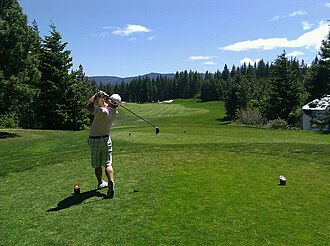
Golf is a club-and-ball sport in which players use various clubs to hit a ball into a series of holes on a course in as few strokes as possible.
"Golf? Nuts! I never did see any fun in a game, where if I hit a ball, I had to chase it myself."
Golf"In the beginning the golf ball was made of wood, probably of beech, but the feather ball, or featherie came into existence around 1618, marking the first ball improvement in golf. The feather ball was made in Scotland for more than 200 years until it was superseded by the gutta percha ball in 1848. It was expensive and easily damaged and the single element that dictated that the game was played in its earliest stages by the wealthier sections of the community who could afford the price of the golf balls. The task of crafting a featherie was not only arduous for the ball makers of the time, but very detrimental to their health. The ball makers lungs were filled with feather dust and the constant pressure on the chest of forcing the boiled feathers into the small leather pouch with a special crutch-handled filling rod, took its toll. Even the most experienced ball maker could only manufacture four geather balls in a day, which accounted for their price of three to four shillings, a huge sum at the time and more even than the cost of a golf club."
Golf"Wherever they traveled Scotts took their favorite pastime with them. They set up courses and founded golf clubs. None made a more significant contribution to the mass explosion of golf in the late nineteenth and early twentieth centuries, than two expatriate Scottish school friends from Dunfermline in Fife, John Reid and Robert Lockhart, although neither is likely to have realised it at the time. Reid is regarded as the father of American golf, as we will see later, but Lockhart had a significant part to play as well. While Reid was introducing golf to the United States, essentially for the first time, the game was spreading like wildfire in the British Isles. Scottish professionals were imported south of the border into England and to Ireland and Wales to lay out courses to meet the new demand for the game. A measure of the demand for their services is the huge increase evident in the number of golf clubs founded in the last two decades of the nineteenth century. Prior to that period the majority of clubs were in Scotland. In 1864 there were about 30 golf clubs in Scotland while in england there were only three - Royal Blackheath, old Machester and Westward Ho! By 1880 there were 60 clubs in Britain; by 1890 there were 387 and by the start of the new millennium Britain had almost 2500 clubs. The Scots pioneers had done their work well."
Golf"The first Scot who tried to influence the game to any real extent did not attempt to do so for the betterment of the game at all; in fact he went to some lengths to try to stop it altogether. Perhaps it was an early example of the Scots perversity in forbidding themselves to do what they want to do, as George Pottinger commented in his excellent account of the history of the Honourable Company, that King James II issues an infamous decree banning the game altogether in 1457. It had no effect of course, for the Scots had more interest in putting their wits against the links than in entertaining any fear of His Majestys wrath because of their refusal to practice archery for defence of the nation at a time when the King was warring on several fronts. Even the threat of being taken by the Kings officiars was not sufficient to curtail the golfing desires of the populace. Fourteen years later another Royal decree, this time by King James IIs successor, James III, commanding that fute-ball and be abused in time coming, had as little effect on the population as the first one, and when James IV tried to ban the game again twenty years later he got just as short shrift. There was at least some salvation for James IV, for he took to the game himself after signing a treaty of Perpetual Peace with England, presumably making the requirement for archery practice less pressing in the process. His Treaty may have been a victory for hope over experience before or since, but at least it gave him some breathing space after having had the sense to take to the links himself."
Golf"According to the Environmental Protection Agency, “[T]he average American family of four uses 400 gallons of water per day.” The average golf course uses 312,000 gallons of water, according to Audobon International, meaning each one uses as much water as 780 families of four. In Palm Springs—immediately adjacent to a place called Palm Desert—NPR reported that each of the citys 57 courses use about a million gallons a day, or about the same as 2,500 families of four. Looking statewide, the numbers really get fun. California is second only to Florida in the number of golf courses it has: 921. Together, those courses use as much water as 2.8 million people, or about 7 percent of the states population. While middle-class homeowners risk fines for watering their lawns, millions upon millions of gallons of water are wasted every day on a boring leisure sport for the wealthy. “Golf courses are a huge problem,” said Adam Keats of the Center for Biological Diversity, an environmental advocacy group. And part of that huge problem is the people who play it. “Theyre a wealthy elite that have no connection to want or lack,” Keats, head of the centers California Water Law Project, told me over the phone. “Golfers live in a world of excess.”"
Golf"In the beginning, playing fields were needed for golf, and more space was required than for the somewhat similar games that had preceded it. Early sites took the form of city streets, frozen lakes, and then entrancing seashores. These were crafted by nature and by society, but they were discovered by golfers. As the popularity of golf grew, however, so too did peoples desire to shape their playing fields. In todays game, where professional architects carefully plot and plan every detail of a new layout, its nearly impossible to comprehend the prospect of "discovering" a ready-made golf course. And todays golfers might not recognize the earliest natural playing fields as being in any way related to todays manicured courses. Nor did the games themselves always resemble golf. There were a variety of forebearers to the game we know today. Some passed in and out of existence; others evolved; others migrated across international borders. Over hundreds of years, those games rattled around like balls ina lottery drawing until, from all of these, came golf."
Golf"It is worth repeating that the principles of art have little or no connection to the original links of Scotland, although the latter resemble savannas whose wildly undulating terrain represents the opposite or arrangement. In fact, the first classic holes did not arise naturally from the land- but came about when greenkeepers and professionals modified it. Through logical thinking and good taste, these pioneering designers employed principles of art they had probably never heard of."
Golf"In Ireland, modern golf began in Belfast in 1881 in the north and at the Curragh in 1883 in the south. In 1888, a club was founded that became the Royal Portrush Golf Club in 1895 in County Antrim in Northern Ireland. In 1951, it hosted the Open Championship, the only course outside of Great Britain to host the tournament. Royal Portrush is rated one of the best courses in the world."
Golf"With the development of rail travel, it became possible for clubs to cast a wider net and attract leading golfers to a single tournament. The Prestwick Golf Clubs suggests in 1856 that a Grand National Tournament between all the leading clubs should be held. Clubs agreed to hold the tournament at St. Andrews a year later, in July 1857. The event was organized as a team event with a pair of players from each club playing a knockout competition over 30 holes. Eleven clubs were represented. The pair of George Glennie and John Campbell Stewart of Blackheath took the title, being awarded a silver jug."
Golf"Golf course location and design also began to change. By 1914 over 90 percent of courses were inland and the golf course designer came into vogue, led by a quartet of early designers, such as the Heathland Quartet of Willie Park Jr. H.S. Colt, Herbery Forlwer, and J. F. Abercromby. Design and maintenance of grounds, the need for equipment, and operations led to a full-grown golf industry. British demand soon expanded around the world, with dramatic upsurges in gold courses and clubs in North America and continental Europe by 1900 as well as areas of British influence in Asia, Africa, South America, and Australasia. The expansion of golf also provided opportunities for young Scotsmen in particular. It has been estimated that more than 2000 Carnoustie men were hired as professionals by golf clubs around the world by 1900."
Golf"Today golf is an international game played in every corner of the world. It owes that popularity to the pioneering efforts of Scottish golfers in the nineteenth century who built upon the early framework of organisation and spread the gospel of golf with the enthusiasm and dedication of missionaries. As we have already seen thee game had witnessed some early movement out of Scotland to other golfing outposts, taken by royalty to England as far back as the early seventeenth century, by Scottish merchants to far away places like India, where the Royal Calcutta Golf Club dates back to 1829, and by the armed forces to South Carolina in the United States, where golf was played long before the famous Apple Tree Gang founded the first American golf club at Yonkers in New York in 1888. these, however, were isolated pockets; golf was very much vested in the hands of the Scots, and virtually confined within Scotlands borders, until well into the nineteenth century. The reasons were simple: only the Scots knew how to play, they had the skills to manufacture the clubs and balls required to play; they were the only nation then with any experience of laying out a course upon which to play and relatively poor communications and transport had, broadly speaking left the game as yet unexposed to the wider world. Two things changed all that. Firstly the discovery that the rubber from a gutta percha tree could be easily and cheaply moulded into a much more servicable golf ball than the expensive featherie, the only option until 1848, thus opening the game up to a much wider audience. Secondly there was the rapid expansion of the Victorian era which brought new prosperity to the middle classes and with it an improved transport system. Many of the now mobile English middle class imitated the royal family by holidaying in Scotland, where they discovered the delights of golf and then took the game back with them south of the border."
Golf"As the game developed, separate teeing grounds were eventually established and the golf course in the form we know it today gradually began to emerge. The players relied on the rabbits and the sheep to keep the grass short-cropped, for it was not until the early part of the twentieth century that mechanized grass cutting began to take over from the animals in golf course management. Indeed many of Britains seaside links, Saunton sands in Devon being a classic example, relied exclusively on rabbits to keep their fairways tightly cropped until well into the second half of the twentieth century when the myxomatosis epidemic of the 1950s killed so many of the rabbits off."
Golf




