Quote
"To find a substitute for laboratory experiments, economists pay close attention to the natural experiments offered by history."
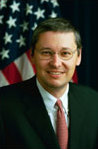 Greg Mankiw
Greg Mankiw
Greg Mankiw
Nicholas Gregory Mankiw is an American macroeconomist who is currently the Robert M. Beren Professor of Economics at Harvard University. Mankiw is best known in academia for his work on New Keynesian economics.
"To find a substitute for laboratory experiments, economists pay close attention to the natural experiments offered by history."
Greg Mankiw"The circular-flow diagram offers a simple way of organizing the economic transactions that occur between households and firms in the economy. The two loops of the circular-flow diagram are distinct but related. The inner loop represents the flows of inputs and outputs. The households sell the use of their labor, land, and capital to the firms in the markets for the factors of production. The firms then use these factors to produce goods and services, which in turn are sold to households in the markets for goods..."
Greg Mankiw"Microeconomics and macroeconomics are closely intertwined. Because changes in the overall economy arise from the decisions of millions of individuals, it is impossible to understand macroeconomic developments without considering the associated microeconomic decisions."
Greg Mankiw"Today, Keynesian theorizing does not inspire whispers and giggles from the audience. There are many economists under the age of forty who do not take offense when their work is called ‘Keynesian’, and I count myself as one of them. If Keynesian economics was dead in 1980, then today it has been reincarnated."
Greg Mankiw"Although Keynes’s General Theory provides the foundation for much of our current understanding of economic fluctuations, it is important to remember that classical economics provides the right answers to many fundamental questions."
Greg Mankiw"Market power and externalities are examples of a general phenomenon called market failure—the inability of some unregulated markets to allocate resources efficiently. When markets fail, public policy can potentially remedy the problem and increase economic efficiency. Microeconomists devote much effort to studying when market failure is likely and what sorts of policies are best at correcting market failures. As you continue your study of economics, you will see that the tools of welfare economics developed here are readily adapted to that endeavor. Despite the possibility of market failure, the invisible hand of the marketplace is extraordinarily important."
Greg Mankiw"Economics is a young science, and there is still much to be learned. Economists sometimes disagree because they have different hunches about the validity of alternative theories or about the size of important parameters that measure how economic variables are related."
Greg Mankiw"It is too early to say there is a consensus about how all these topics fit together. Yet one can say that the new classical challenge has been met: Keynesian economics has been reincarnated into a body with firm microeconomic muscle."
Greg Mankiw"After more than a quarter-century as a professional economist, I have a confession to make: There is a lot I don’t know about the economy. Indeed, the area of economics where I have devoted most of my energy and attention — the ups and downs of the business cycle — is where I find myself most often confronting important questions without obvious answers."
Greg Mankiw"Colander: What’s your view of the New Keynesian approach? Tobin: I’m not sure what that means. If it means people like Greg Mankiw, I don’t regard them as Keynesians. I don’t think they have involuntary unemployment or absence of market clearing. It is a misnomer to call Mankiw any form of Keynesian. Colander: How about real-business-cycle theorists? Tobin: Well, that’s just the enemy."
Greg Mankiw




