SHAWORDS
Hydrogenation

Hydrogenation

Hydrogenation

Hydrogenation

author
7Quotes

Hydrogenation is a chemical reaction between molecular hydrogen (H2) and another compound or element, usually in the presence of a catalyst such as nickel, palladium or platinum. The process is commonly employed to reduce or saturate organic compounds. Hydrogenation typically constitutes the addition of pairs of hydrogen atoms to a molecule, often an alkene. Catalysts are required for the reaction

Popular Quotes

7 total
Quote
"Reductions of α,β-unsaturated ketones with solutions of Li, Na, or K in liquid NH3 are chemoselective, resulting in the exclusive reduction of the carbon-carbon double bonds. … The regiospecific generation of enolate ions from α,β-unsaturated ketones is an important tool in carbon-carbon- bond-forming reactions. Catalytic hydrogenation of an enone would not be chemoselective if an isolated double bond were also present in the molecule. However, isolated double bonds are inert to dissolving metal reduction. On the other hand, a variety of functional groups are reduced with alkali metals in liquid ammonia. These include alkynes, conjugated dienes, allylic, or benzylic halides and ethers. Nonconjugated ketones can be reduced in the dissolving metal medium to the corresponding saturated alcohol in the presence of excess alcohol prior to workup."
HydrogenationHydrogenation
Quote
"Platinum and palladium are the most common laboratory catalysts for alkene hydrogenations. … Catalytic hydrogenation, unlike most other organic reactions, is a heterogeneous process rather than a homogeneous one. … An interesting feature of catalytic hydrogenation is that the reaction is extremely sensitive to the steric environment around the double bond. As a result, the catalyst usually approaches only the more accessible face of an alkene, giving rise to a single product. … Alkenes are much more reactive than most other unsaturated functional groups toward catalytic hydrogenation, and the reaction is therefore quite selective. … In addition to its usefulness in the laboratory, catalytic hydrogenation is also important in the food industry, where unsaturated vegetable oils are reduced on a large scale to produce the saturated fats used in margarine and cooking products."
HydrogenationHydrogenation
Quote
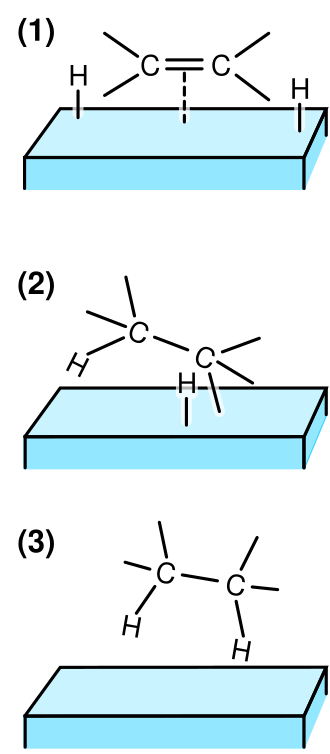
"The mechanism of heterogenous hydrogenation involves (1) dissociative chemisorption of H2 on the catalyst, (2) coordination of the alkene to the surface of the catalyst, and (3) addition of the two hydrogen atoms to the activated π-bond in a syn- manner.… For low-pressure hydrogenations (1-30 atm), Pt, Pd, Rh, and Ru are used. The reactivity of a given catalyst decreases in the following order: Pt > Pd > Rh ~ Ru > Ni. For high-pressure hydrogenations (100-300 atm), Ni is usually the metal of choice. … The activity of a given catalyst generally is increased by changing from a neutral to a polar to an acid solvent. EtOAc, EtOH, and HOAc are the most frequently used solvents for low-pressure hydrogenations. … The reactivity of unsaturated substrates decreases in the following order: RCOCl > RNO, > RC-CR > RCH≡CHR > RCHO > RC≡N > RCOR > benzene. Both Pt and Pd catalysts fail to reduce RCOOR, RCOOH, and RCONH, groups. Pd is usually more selective than Pt. The ease of reduction of an olefin decreases with increasing substitution of the double bond. Conjugation of a double bond with a carbonyl group can markedly increase the rate of hydrogenation of the double bond. … With Pt and Pd catalysts, hydrogenation of allylic and benzylic alcohols, ethers, esters, amines, and halides is often accompanied by hydrogenolysis of the C-X bond where X = OH, OR, OAc, NR2, or halide, respectively."
HydrogenationHydrogenation

Similar Authors & Thinkers