Quote
"Should the merit of science being fear of the ignorant, and love and honour for the scholars, that alone should encourage striving for it. What then about its other virtues in this world and the other."
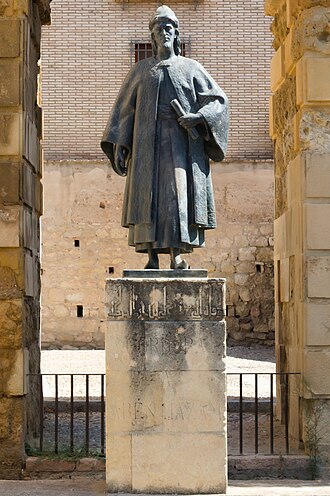 Ibn Hazm
Ibn Hazm
Ibn Hazm
Ibn Hazm was an Andalusi Muslim polymath, historian, traditionist, jurist, philosopher, and theologian, born in the Córdoban Caliphate, present-day Spain. Described as one of the strictest hadith interpreters, Ibn Hazm was a leading proponent and codifier of the Zahiri school of Islamic jurisprudence, and produced a reported 400 works, of which 40 still survive.
"Should the merit of science being fear of the ignorant, and love and honour for the scholars, that alone should encourage striving for it. What then about its other virtues in this world and the other."
Ibn Hazm"If you attended (a study session) strictly adopt three attitudes; there is no fourth. First: You can lock yourself in the silence of ignorance. Second: If you do not behave as such, ask for the questions a man seeking to learn asks…. This man will ask only about what he does not know, not about what he knows. Asking about matters one knows is making proof of ineptitude; this is only ranting, waste of time for everyone…. If the person you are questioning does not give satisfactory answers, stop questioning… Third: You can answer like a scientist, refuting clearly the other’s arguments. If you are not capable of that, do not insist….”"
Ibn Hazm"If science, and devoting oneself to it, had no other use than avoiding exhausting temptations, rushes of hope that give worry, and thoughts that sadden the soul, that alone should give us reasons to seek it… Kinglets have sought distraction in chess, wine, music, hunting and much else that only bring harm in this world and the other."
Ibn Hazm"Whosoever has a natural leaning towards a science, even if it was less noble than another, should not abandon it for the other because if he did he would be like someone who would be growing coconuts in al-Andalus and olive trees in India, crops that would never fructify."
Ibn Hazm"Blame from a man with a corrupt soul in opposing him, and refraining from evil deeds is better for you than his esteem if you did evil."
Ibn Hazm"If you pride yourself with your science, then you must realize that you have no merit; science is a gift that God has granted you. Thus do not acknowledge it in a way that angers the Highest, because he could erase it from your head through an illness of some sort."
Ibn Hazm"There is no worse calamity for science and for scholarship than those intruders who are foreign to them. They are ignorant and yet think they know; they ruin everything whilst convinced they are fixing all."
Ibn Hazm"Whosoever is miserly with the gift of his knowledge deserves more blame than whosoever is miserly with his money, because the man miserly with his money fears exhausting what he has, but the one miserly with his science is with an object which does not become exhausted with use, and that he would lose nothing in sharing it."
Ibn Hazm"Also be aware that many men eager for science, read, study, and research with application, but derive no fruit. The man of science must realize that if application alone was enough, many other men would be superior to him. Science, thus, is certainly a gift from the Highest. What place is left for pride, thus? We can only accept in humility, and give thanks to God, asking him to increase his bounty, and beg him not to deprive us of it."
Ibn Hazm"The most noble sciences, are those which bring us closer to the Creator; those which help us be pleasing to Him."
Ibn Hazm"I have seen men who had studied the sciences, who knew the messages of the Prophets, the recommendations of the wise, and yet who surpassed the most evil men in their worse deeds, and their depravation. This is very frequent, and so I have understood that these two moral attitudes were favours granted or denied by the Most High."
Ibn Hazm"I have come across most people- with the exception of those that God most High has protected-they rush into misery, worry, the exhaustion of this world, and amassing terrible sins, that will earn them hell-fire, gaining nothing in pursuing their evil deeds… And they know that their evil intentions will neither fulfill their wishes, nor bring any gains; and that with purer intentions they will obtain great rest for their souls."
Ibn Hazm




