Quote
"Many strong temples which would have remained unshaken even by the trumpet blown on the Day of Judgment, were levelled with the ground when swept by the wind of Islam."
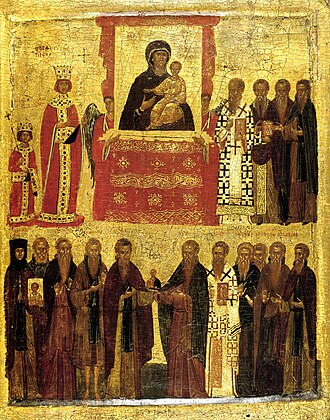 Iconoclasm
Iconoclasm
Iconoclasm
Iconoclasm is the belief in the importance of the destruction of icons and other images or monuments, often for religious or political reasons. Those who engage in or support iconoclasm are called iconoclasts, a term that has come to be applied figuratively and more broadly to anyone who challenges "cherished beliefs or venerated institutions on the grounds that they are erroneous or pernicious".
"Many strong temples which would have remained unshaken even by the trumpet blown on the Day of Judgment, were levelled with the ground when swept by the wind of Islam."
Iconoclasm"That magnificent mansion which it had taken many years to raise, was destroyed in a few moments. He got the idols broken and they were handed over to the butchers for being used as weights while selling meat. The biggest idol which had the form of a ram was reduced to powder which was put in betel-leaves to be given to the Rajpûts so that they could eat their god.”"
Iconoclasm"…The temple of Nagarkot, which is outside the city, was taken at the very outset… On this occasion many mountaineers became food for the flashing sword. And that golden umbrella, which was erected on the top of the cupola of the temple, they riddled with arrows… And black cows, to the number of 200, to which they pay boundless respect, and actually worship, and present to the temple, which they look upon as an asylum, and let loose there, were killed by the Musulmans. And, while arrows and bullets were continually falling like drops of rain, through their zeal and excessive hatred of idolatry they filled their shoes full of blood and threw it on the doors and walls of the temple… the army of Husain Quli Khan was suffering great hardships. For these reasons he concluded a treaty with them… and having put all things straight he built the cupola of a lofty mosque over the gateway of Rajah Jai Chand."
Iconoclasm"But the northern provinces being first conquered, the feat of the Mahomedan government fixed, and its greatest force exerted in those parts ; most of the temples were destroyed, the images of stone broken, and those of metal melted to cover the floors of the mosques and palaces, that the faithful Musulman should have the satisfaction daily to trample on what had been held sacred by the Hindoo."
Iconoclasm"One often hears that between the thirteenth and eighteenth centuries, Indo-Muslim states, driven by a Judeo-Islamic “theology of iconoclasm,” by fanaticism, or by sheer lust for plunder, wantonly and indiscriminately indulged in the desecration of Hindu temples. Such a picture, however, cannot be sustained by evidence from original sources for the period after 1192. Had instances of temple desecration been driven by a “theology of iconoclasm,” as some have claimed, such a theology would have committed Muslims in India to destroying all temples everywhere, including ordinary village temples, as opposed to the highly selective operation that seems actually to have taken place."
Iconoclasm"And, above all, dont let us forget India, the cradle of the human race, or at least of that part of it to which we belong, where first Mohammedans, and then Christians, were most cruelly infuriated against the adherents of the original faith of mankind. The destruction or disfigurement of the ancient temples and idols, a lamentable, mischievous and barbarous act, still bears witness to the monotheistic fury of the Mohammedans, carried on from Mahmud the Ghaznevid of cursed memory down to Aureng Zeb, the fratricide, whom the Portuguese Christians have zealously imitated by destruction of temples and the auto da fe of the inquisition at Goa."
Iconoclasm"The idols he saw amazed him… Next day he got those idols of gold smashed with stones. The pillars of wood were burnt down by his order… A cry rose from the temples as if a second Mahmud had taken birth."
Iconoclasm"Each winter Mahmud descended into India, filled his treasure chest with spoils, and amused his men with full freedom to pillage and kill; each spring he returned to his capital richer than before. At Mathura (on the Jumna) he took from the temple its statues of gold encrusted with precious stones, and emptied its coffers of a vast quantity of gold, silver and jewelry; he expressed his admiration for the architecture of the great shrine, judged that its duplication would cost one hundred million dinars and the labor of two hundred years, and then ordered it to be soaked with naphtha and burnt to the ground... Aurangzeb cared nothing for art, destroyed its "heathen" monuments with coarse bigotry, and fought, through a reign of half a century, to eradicate from India almost all religions but his own. He issued orders to the provincial governors, and to his other subordinates, to raze to the ground all the temples of either Hindus or Christians, to smash every idol, and to close every Hindu school."
Iconoclasm




