Quote
"Sanskrit, the faithful guardian of old Indo-European forms, exhibits these remarkable [PIE inflection] properties better than any other member of the Aryan line of speech."
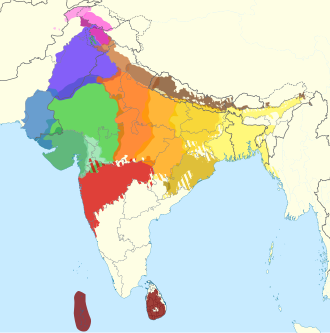 Indo-Aryan languages
Indo-Aryan languages
Indo-Aryan languages
The Indo-Aryan languages are a branch of the Indo-Iranian languages in the Indo-European language family. As of the early 21st century, there were 800 million speakers, primarily concentrated east of the Indus River in South Asia, spread across Eastern Pakistan, Northern India, southern Nepal, Bangladesh, Sri Lanka, and Maldives. Moreover, apart from the Indian subcontinent, large immigrant and ex
"Sanskrit, the faithful guardian of old Indo-European forms, exhibits these remarkable [PIE inflection] properties better than any other member of the Aryan line of speech."
Indo-Aryan languages"“All the Dravidian languages known to us fairly bristle with loans from Sanskrit and the Aryan vernaculars. Dravidian literature in South India came into existence under the impulse and influence of Sanskrit literature and speech. Wherever there is a correspondence in the vocabularies of Sanskrit and Dravidian, there is a presumption, to be removed only by specific argument, that Sanskrit has been the lender, Dravidian the borrower.” ....“If a word can be explained easily from material extant in Sanskrit itself, there is little chance for such a hypothesis”."
Indo-Aryan languages"“All these linguists are operating on the assumption, based on other criteria, that the Aryans ‘must have’ invaded India where there could not have been a ‘linguistic vacuum’”... “they are not internally consistent, since the opinions of the principal linguists in this area have differed quite considerably. This problematizes the value of this method as a significant determinant in the Indo-Aryan debate…”.... “the theory of Aryan migrations must be established without doubt on other grounds for research into pre-Aryan linguistic substrata to become meaningful. However, the ‘evidence’ of a linguistic substratum in Indo-Aryan, in and of itself, due to its inconclusive nature, cannot be presented in isolation as decisive proof in support of the theory of Aryan invasions or migrations into the Indian subcontinent.”"
Indo-Aryan languages"“not a single case in which a communis opinio has been found confirming the foreign origin of a Rgvedic (and probably Vedic in general) word”.... [there is] “not a single bit of uncontroversial evidence on the actual spread of Dravidian and Austro-Asiatic in prehistoric times, so that any statement on Dravidian and Austric in Rgvedic times is nothing but speculation”. ...“Many of the arguments for (or against) such foreign origin are often not the results of impartial and thorough research, but rather of (often wistful) statements of faith.”"
Indo-Aryan languages"Vedic (and Avestan) had "three genders, three numbers and eight cases, the fullest representation of the Indo-European system" (LOCKWOOD 1972:215).... "Greek and Sanskrit […] there are so few completely regular verbs in these languages. It is the irregular and defective verb which best reflects the prehistoric background" (LOCKWOOD 1972:109)."
Indo-Aryan languages"There has been a certain amount of controversy concerning the question of non-Aryan loan-words in Sanskrit, and some scholars (P. Thieme, H.W. Bailey) have adopted a sceptical position in this respect. Alternate Indo-European etymologies have been offered for words for which a Dravidian or Munda etymology had previously been proposed, in some cases successfully (…)but more dubious in other cases."
Indo-Aryan languages




