SHAWORDS
Intrauterine device

Intrauterine device

Intrauterine device

Intrauterine device

author
16Quotes

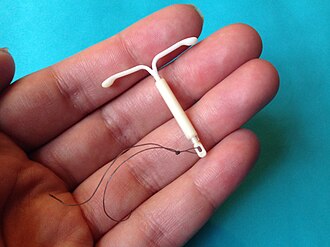
The intrauterine device (IUD), also known as an intrauterine contraceptive device, is a small, T-shaped birth control device that is inserted into the uterus to prevent pregnancy. IUDs are a form of long-acting reversible contraception (LARC).

Popular Quotes

16 total
Quote
"During the ninth century, a Persian physician recommended inserting into the cervix paper wound tightly into the shape of a probe, tied with a string and smeared with ginger water (Manisoff, 1973). Also, during certain rituals, the Maori people of New Zealand put small pebbles into women’s vaginas to make them “sterile as stones” (Himes, 1963). Similarly, Casanova, who claimed to have invented almost everything that has to do with sex, soaked a small gold ball in an alkaline solution and inserted it in his lover’s vagina (Suitters, 1967)."
Intrauterine deviceIntrauterine device
Quote
"Alan F. Guttmacher, chief of obstetrics at Mount Sinai Hospital in New York City and a member of the medical advisory committee of the council, had warned against intrauterine devices in his popular marriage manual, but when a member of his department at Mount Sinai approached him in 1958 with an idea for a new kind of IUD, Guttmacher listened. Dr.Lazar Margulies, who was Berlin trained and who had used an intrauterine device in the late twenties in Berlin came to me with the idea that an intrauterine device could be made of molded plastic and the advantage was that you could stretch it to a linear form. . . and it would resume its original shape. Marguies has been inspired to give the old method a second look when he heard John Rock, the Harvard gynecologist who had served on the AMA committee on contraception in the 1930s and who has the object of an intense lobbying effort by Robert Dickinson, lecture on the dangers of overpopulation. The substitution of plastic for wire meant that the device could be inserted without dilating the cervix (stretching the mouth of the womb), a painful procedure that required local anesthesia. The molded plastic coil was unwound into a thin rod, the rod slipped into the uterus, and the coil pushed out of the rod into the uterus, where it regained its original shape. Guttmacher allowed Margulies to try out the device “with some fear and hesitation because I was taught in medical school how dangerous the intrauterine device was.” They worked. Patients did not die of pelvic inflammatory disease or develop galloping cancer."
Intrauterine deviceIntrauterine device
Quote
"The history of the intrauterine device is remarkably short and its survival has been jeopardized several times from the beginning when Gräfenberg introduced the intrauterine ring in 1928, and later when product liability claims in the USA forced companies to withdraw the IUD from the market. However, a revival is happening, and one of the withdrawn copper IUDs has been re-introduced in the USA. In the 1980s, pessimism about the future of the IUD was based on the fact that there are still two major imperfections inherent in intrauterine contraception: its lack of protection against both gyne and sexually transmitted disease."
Intrauterine deviceIntrauterine device
Quote
"Dr J. Lippes (Figure 3) is an example of the thoroughbred American (born at Buffalo, NY in 1925), who since 1957 has been Head of the Department of Obstetrics and Gynecology of the State University of New York at Buffalo. Although he had become acquainted with the Gräfenberg Ring in 1952, he had not dared to use it for fear of being accused of malpractice. Seven years later, two papers on intrauterine contraception appeared, both in English. The first, written by the Japanese gynecologist Ishihama and published in the Yokohama Medical Journal, gave an enthusiastic clinical assessment of the Ota Ring. In the second paper, Dr W. Oppenheimer of Jerusalem overviewed the results of three decades of personal experience with the modified Silk Ring. The fact that the latter paper had been accepted by the authoritative American journal of Obstetrics and Gynecology was perceived by Dr Lippes as a sign that intrauterine contraception had become a discussable subject in his country. That same year he started inserting Silk and Presea Rings under the auspices of the Buffalo PIanned Parenthood Center. The former device being too flexible, and the latter too stiff, Dr Lippes decided to remove the spokes from the Ota Ring and affix a piece of monofilament nylon to the IUD to facilitate removal and to allow the wearer to check that the device was still present. However, the modified Ring tended to rotate in utero and to wind the marker thread into the cavity, eliminating its intended uses. Therefore, to prevent IUD rotation, a radical change of shape was needed. After many experiments, the double-S Loop (the Lippes Loop) emerged in 1961. Due to its particular shape (trapezoid), the Lippes Loop fits the (relaxed uterine cavity snugly. The Lippes Loop was to become extremely popular and, of all first-generation IUDs, had the greatest worldwide impact."
Intrauterine deviceIntrauterine device
Quote
"In fact, Dr Lippes had a predecessor in this field; Dr Lazar C. Margulies (Figure 4). Dr Margulies was born in Galicia (now part of Poland) in 1895. As a medical student, he had served in the Austro-Hungarian army during World War I. Following the armistice, he graduated from the University of Vienna in 1921, where he specialized in obstetrics and gynecology. He started practising in Vienna, but, expelled from the hospital, this Jewish gynecologist emigrated to the USA in 1941. In New York City he joined the staff of the Mount Sinai Medical Center in 1954 and was promoted to Associate Professor 9 years later. Dr Margulies died of a cerebral hemorrhage in 1982. His Chief at Mount Sinai, Dr Alan Guttmacher, who had opposed intrauterine contraception during Gräfenbergs life (Gräfenberg himself had practised at Mount Sinai for a decade and a ha1f) encouraged Dr Margulies to attempt to improve the Silver Ring. Most certainly, Guttmachers change of mind was prompted by the alarm over the worlds demographic surge, and was reinforced by the 1959 IUD papers from Israel and Japan. Gambling on the use of thermoplastics, Dr Margulies conceived his famous spiral-shaped IUD in 1960, the Perma-Spiral, marketed by the Ortho Pharmaceutical Company as Gynecoil. To insert the Margulies Spiral, the unwound device was introduced into a thin plastic tube and expelled with a plastic plunger. Dr Lippes later borrowed this technique for the insertion of his Loop IUD."
Intrauterine deviceIntrauterine device
Quote
"There are two inconsistencies in the “pro-life” movement from the viewpoint of pro-choices: There appears to be relatively little mention of IUD’s (Intra-uterine devices). The precise mechanism by which IUDS prevent pregnancy is unknown. Some researchers believe that the IUD immobilizes sperm, preventing them from reaching the ovum. Others believe that it causes the ovum to pass through the fallopian tube so fast that it is unlikely to be fertilized. Most believe that the IUD interferes with the implantation of fertilized ovum in the uterine wall. If the third property is true, then IUDs terminate the development of a fertilized ovum after conception, and cause its expulsion from the body. To a person who believes that human personhood begins at the instant of conception, there is no difference between using an IUD, having a first trimester abortion, or having a partial birth abortion, or –for that matter –strangling a newborn just after birth. Yet pro-life groups actively campaign against PBA’s, picket abortion clinics, and attempt to pass restrictive legislation limiting choice in abortion. Some have made negative statements about IUDs. But none have, to our knowledge, picketed IUD manufacturing facilities, or sponsored anti-IUD legislation. This is surprising, because in those countries where IUDs are widely used, the number of fertilized eggs which IUDs apparently expel from women’s bodies far exceeds the number of surgical abortions. About 43% of American women will have had a surgical abortion sometime during their lifetime. Women who use an IUD will expel about one fertilized ovum annually (assuming that they engage in intercourse once per week) IUDS are becoming increasingly popular. Two studies have reported effectiveness rates of 99.4 and 99.9%"
Intrauterine deviceIntrauterine device
Quote
"Because the first intrauterine contraceptive device proposed by Dr Richard Richter in 1909 was ignored, the Silver Ring of Dr Ernst Gräfenberg (1928) is currently labeled as the prototype of modern IUD generations. The Ring of Gräfenberg, however, was proscribed in the 1930s, and, although the basis for the condemnation was more political than scientific, three decades had passed before the rebirth and general acceptance of intrauterine contraception. The development of the plastic IUDs, announced by Dr Lazar Margulies and Dr Jack Lippes in 1960-61, solved the insertion problem of metallic IUDs, but did not eliminate the main side-effects, that is, bleeding and pain. In 1969, the first copper-bearing device was introduced by Dr Jaime Zipper and Dr Howard Tatum. The metallic contraceptive adjuvant, though allowing reduction of the platform size, did not solve the menorrhagia problem. This was achieved by Dr Tapani Luukkainen thanks to the invention of the gestagen- releasing IUD (Ng Nova-T) in 1977. The final step in IUD engineering was the invention of the GyneFix, a flexible, frameless copper-bearing IUD anchored permanently to the uterine tissues, which the inventor (Dr Dirk Wildemeersch) calls an intrauterine contraceptive implant or IUCI."
Intrauterine deviceIntrauterine device
Quote
"By the late 1960s discussion of the population problems of underdeveloped countries had helped to stimulate renewed interest in family planning programs in the United States. Happy, there was a growing discussion about the social and philosophical issues involved in the management of human reproduction, whereas only a decade before, informed interest had been limited to a few social scientists. The whole nature of the debate, however, as well as the prospects for controlling population growth, had been radically altered by the availability of the plastic intrauterine device, an American gift to the world."
Intrauterine deviceIntrauterine device
Quote
"Tietze’s new studies showed that population control programs with conventional methods “were getting nowhere fast.” Intensive review of old methods continued, but reported results remained contradictory, probably reflecting differences in motivation between populations. Some members of the Population Council were convinced by the futility of programs based on conventional methods that something better had to be found. Frank Notestein, who succeeded Fredrick Osborn as president of the Population Council in 1958, remembers his frustration in knowing that something had to be done to control rapid population growth but lacking the contraceptive means that would enable the council to take decisive action. “I’ve never been in another situation in my life that made me feel so helpless.” It was this sense of urgency which prompted a reevaluation of intrauterine devices."
Intrauterine deviceIntrauterine device
Quote
"In 1909, an authoritative German medical journal, Deutsche medizinische Wochenschrift, published a paper by Dr Richter of Waldenburg (near Breslaw) entitled Ein Mittel zur Verhütung der Konzeption (a means of preventing conception). Because of the taboo surrounding contraception, the very title of the article will no doubt have surprised many readers and shocked some. The device described by Dr Richter was the first genuine IUD. It consisted of two strands of coarse silkworm gut (crin de Florence) wound in a particular pattern, the free ends of which were capped with celluloid to prevent injury to the endometrium. The threads were united by a thin bronze filament to diagnose expulsion and to facilitate retrieval of the IUD, which was inserted using a metal female bladder catheter. Dr Richters invention had no impact on the practice of birth control and clinical data were never supplied. Contraception continued to use the traditional interuterine devices, for example, the metal wishbone spring pessary patented by Dr Carl Hollweg (1902) and the cervico-uterine pessary made of silkworm gut attached to a cervical glass button described by Dr Karl Pust."
Intrauterine deviceIntrauterine device

Similar Authors & Thinkers



