SHAWORDS
J

James Tod

James Tod

James Tod

author
5Quotes

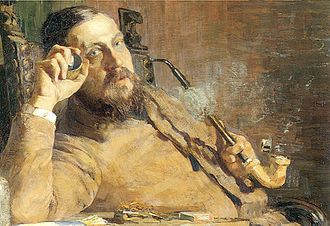
Lieutenant-Colonel James Tod was a British army officer and scholar. He combined his official role and his amateur interests to create a series of works about the history and geography of India, and in particular the area then known as Rajputana that corresponds to the present day state of Rajasthan, and which Tod referred to as Rajast'han.

Popular Quotes

5 total
Quote
"[Once in a while, ladies with courage and virtue, stood up against the royal advances like the wife of Prithviraj Singh, Rae Singhs younger brother. She was a princess of Mewar and once on returning from the fair found herself entangled amidst the labyrinth of apartments at the end of which Akbar stood before her,] “but instead of acquiesence, she drew a poniard from her corset and held it to his breast, dictating, and making him repeat the oath of rununciation of the infamy of all her race"."
J
James Tod
Quote
"Ujameda, by his wife, Nila, had five sons, who spread their branches on both sides of the Indus. Regarding three the Puranas are silent, which implies their migration to distant regions. Is it possible they might be the origin of the Medes? These Medes are descendants of Yciyat, third son of the patriarch, Menu: and Madai, founder of the Medes, was of Japhet’s line. Aja Merle, the patronymic of the branch of Bajaswa, is from Aja ‘a goat.’ The Assyrian Mede in Scripture is typified by the goat.‘"
J
James Tod
Quote
"In Tod’s description, the ‘Marusthali’, as it was then called, consists of ‘expansive belts of sand, elevated upon a plain only less sandy, and over whose surface numerous thinly peopled towns and hamlets are scattered’. He also records ‘the tradition of the absorption of the Caggar river, as one of the causes of the comparative depopulation of the northern desert’. This tradition was transmitted in the form of a ‘couplet still sung among Rajputs, which dates the ruin of this part of the country back to the drying up of the Hakra.’ Although Tod could not recall the exact text of the said song, he acknowledged ‘the utility of these ancient traditional couplets’. ‘Folk history’, as we would call it today... Yet, James Tod finds worthy of mention a tradition alive in the 1810s that blames the region’s ‘depopulation’ on the Ghaggar’s ‘absorption’ or disappearance; he even notes how ‘the vestiges of large towns, now buried in the sands, confirm the truth of this tradition, and several of them claim a high antiquity."
J
James Tod
Quote
"“My own animadversions upon the defective condition of the annals of Rajwarra have more than once been checked by a very just remark: ‘When our princes were in exile, driven from hold to hold, and compelled to dwell in the clefts of the mountains, often doubtful whether they would not be forced to abandon the very meal preparing for them, was that a time to think of historical records?’ ”... “If we consider the political changes and convulsions which have happened in Hindustan since Mahmood’s invasion, and the intolerant bigotry of many of his successors, we shall be able to account for the paucity of its national works on history, without being driven to the improbable conclusion, that the Hindus were ignorant of an art which has been cultivated in other countries from almost the earliest ages. Is it to be imagined that a nation so highly civilized as the Hindus, amongst whom the exact sciences flourished in perfection, by whom the fine arts, architecture, sculpture, poetry, music, were not only cultivated, but taught and defined by the nicest and most elaborate rules, were totally unacquainted with the simple art of recording the events of their history, the character of their princes and the acts of their reigns?” [The fact appears to be that] “After eight centuries of galling subjection to conquerors totally ignorant of the classical language of the Hindus; after every capital city had been repeatedly stormed and sacked by barbarous, bigoted, and exasperated foes; it is too much to expect that the literature of the country should not have sustained, in common with other interests, irretrievable losses.”"
J
James Tod
Quote
"Those who expect from a people like the Hindus a species of composition of precisely the same character as the historical works of Greece and Rome commit the very gregarious error of overlooking the peculiarities which distinguish the natives of India from all other races, and which strongly discriminate their intellectual productions of every kind from those of the West. Their philosophy, their poetry, their architecture, are marked with traits of originality; and the same may be expected to pervade their history, which, like the arts enumerated, took a character from its intimate association with the religion of the people. It must be recollected, moreover,… that the chronicles of all the polished nations of Europe, were, at a much more recent date, as crude, as wild, and as barren, as those of the early Rajputs."
J
James Tod

Similar Authors & Thinkers