Quote
"Space tells matter how to move Matter tells space how to curve"
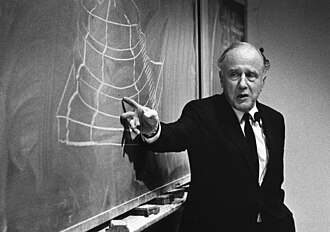 John Archibald Wheeler
John Archibald Wheeler
John Archibald Wheeler
John Archibald Wheeler was an American theoretical physicist. He was largely responsible for reviving interest in general relativity in the United States after World War II. Wheeler also worked with Niels Bohr to explain the basic principles of nuclear fission. Together with Gregory Breit, Wheeler explored positron-electron pair production from the collision of two photons, now known as the Breit–
"Space tells matter how to move Matter tells space how to curve"
John Archibald Wheeler"There are many modes of thinking about the world around us and our place in it. I like to consider all the angles from which we might gain perspective on our amazing universe and the nature of existence."
John Archibald Wheeler"The best way to learn something is to have to teach it."
John Archibald Wheeler"What we think of as smooth simple space is really a wiggly business."
John Archibald Wheeler"For all our everyday experience, the geometry of space is smooth and flat. But as we examine it more closely, it must show oscillations. And still more closely, it must show foam, a foam-like structure. And that means that down at the very smallest distances, this idea of before and after really lose their meaning."
John Archibald Wheeler"Spacetime tells matter how to move; matter tells spacetime how to curve."
John Archibald Wheeler"The question is—what is the question?"
John Archibald Wheeler"Some people think Wheelers gotten crazy in his later years, but hes always been crazy."
John Archibald Wheeler"Therefore we can afford many mistakes in the search. The main thing is to make them as fast as possible."
John Archibald Wheeler"I had the good fortune of having my first and only heart attack last January ... I call it good fortune because it taught me that theres a limited amount of time left and I better concentrate on one thing: How come existence? How come the quantum? Maybe those questions sound too philosophical, but maybe philosophy is too important to be left to the philosophers."
John Archibald Wheeler"The late, great astrophysicist, philosopher and black hole evangelist John Archibald Wheeler, of Princeton, used to say that the past and the future are fiction, that they only exist in the artifacts and the imaginations of the present."
John Archibald Wheeler"Of all heroes, Spinoza was Einsteins greatest. No one expressed more strongly than he a belief in the harmony, the beauty, and most of all the ultimate comprehensibility of nature."
John Archibald Wheeler