SHAWORDS
John Cassian

John Cassian

John Cassian

John Cassian

author
18Quotes

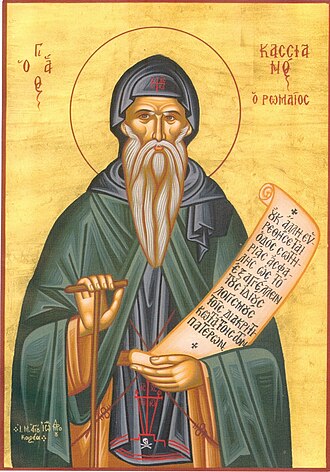
John Cassian, also known as John the Ascetic and John Cassian the Roman,, was a Christian monk and theologian celebrated in both the Western and Eastern churches for his mystical writings. Cassian is noted for his role in bringing the ideas and practices of early Christian monasticism to the medieval West.

Popular Quotes

18 total
Quote
"Yet sometimes the mind which advances to that true disposition of purity and has already begun to be rooted in it, conceiving all of these at one and the same time and rushing through them all like a kind of ungraspable and devouring flame, pours out to God wordless prayers of the purest vigor. These the Spirit itself makes to God as it intervenes with unutterable groans, unbeknownst to us, conceiving at that moment and pouring forth in wordless prayer such great things that they not only—I would say— cannot pass through the mouth but are unable even to be remembered by the mind later on."
John CassianJohn Cassian
Quote
"Some faults grow up without any natural occasion giving birth to them, but simply from the free choice of a corrupt and evil will, as envy and this very sin of covetousness; which are caught (so to speak) from without, having no origination in us from natural instincts. But these, in proportion as they are easily guarded against and readily avoided, just so do they make wretched the mind that they have got hold of and seized, and hardly do they suffer it to get at the remedies which would cure it."
John CassianJohn Cassian
Quote
"This will be the case when every love, every desire, every effort, every undertaking, every thought of ours, everything that we live, that we speak, that we breathe, will be God, and when that unity which the Father now has with the Son and which the Son has with the Father will be carried over into our understanding and our mind, so that, just as he loves us with a sincere and pure and indissoluble love, we too may be joined to him with a perpetual and inseparable love and so united with him that whatever we breathe, whatever we understand, whatever we speak, may be God. In him we shall attain, I say, to that end of which we spoke before, which the Lord longed to be fulfilled in us when he prayed: ‘That all may be one as we are one, I in them and you in me, that they themselves may also be made perfect in unity.’ (John 17:22-23)"
John CassianJohn Cassian
Quote
"Not without reason has this verse [Psalms 70:1] been selected from out of the whole body of Scripture. ... ‘O God, incline unto my aid.’ ... This verse should be poured out in unceasing prayer so that we may be delivered in adversity and preserved and not puffed up in prosperity. You should, I say, meditate constantly on this verse in your heart. You should not stop repeating it when you are doing any kind of work or performing some service or are on a journey. Meditate on it while sleeping and eating and attending to the least needs of nature. This heart’s reflection, having become a saving formula for you, will not only preserve you unharmed from every attack of the demons but will also purge you of every vice and earthly taint, lead you to the theoria of invisible and heavenly realities, and raise you to that ineffably ardent prayer which is experienced by very few. Let sleep overtake you as you meditate upon this verse until you are formed by having used it ceaselessly and are in the habit of repeating it even while asleep."
John CassianJohn Cassian
Quote
"Our third conflict is against covetousness which we can describe as the love of money; a foreign warfare, and one outside of our nature. ... For the rest of the incitements to sin planted in human nature seem to have their commencement as it were congenital with us, and somehow being deeply rooted in our flesh, and almost cœval with our birth, anticipate our powers of discerning good and evil, and although in very early days they attack a man, yet they are overcome with a long struggle.But this disease coming upon us at a later period, and approaching the soul from without, as it can be the more easily guarded against and resisted, so, if it is disregarded and once allowed to gain an entrance into the heart, is the more dangerous to every one, and with the greater difficulty expelled. For it becomes "a root of all evils" [1 Timothy 6:10] and gives rise to a multiplicity of incitements to sin."
John CassianJohn Cassian
Quote
"Gold and the love of gain become to him his god, as the belly does to others. Wherefore the blessed Apostle, looking out on the deadly poison of this pest, not only says that it is a root of all kinds of evil, but also calls it the worship of idols, saying "And covetousness (which in Greek is called φιλαργυρία) which is the worship of idols." [Colossians 3:5] You see then to what a downfall this madness step by step leads, so that by the voice of the Apostle it is actually declared to be the worship of idols and false gods, because passing over the image and likeness of God (which one who serves God with devotion ought to preserve undefiled in himself), it chooses to love and care for images stamped on gold instead of God."
John CassianJohn Cassian
Quote
"This prayer, then, although it seems to contain the utter fullness of perfection inasmuch as it was instituted and established on the authority of the Lord himself, nonetheless raises his familiars to that condition which we characterized previously as more sublime. It leads them by a higher stage to that fiery and, indeed, more properly speaking, wordless prayer which is known and experienced by very few. This transcends all human understanding and is distinguished not, I would say, by a sound of the voice or a movement of the tongue or a pronunciation of words. Rather, the mind is aware of it when it is illuminated by an infusion of heavenly light from it, and not by narrow human words, and once the understanding has been suspended it gushes forth as from a most abundant fountain and speaks ineffably to God, producing more in that very brief moment than the self-conscious mind is able to articulate easily or to reflect upon. Our Lord himself represented this condition in similar fashion in the form of those prayers that he is described as having poured out alone on the mountain and silently, and when he prayed in his agony he even shed drops of blood as an inimitable example of his intense purpose."
John CassianJohn Cassian

Similar Authors & Thinkers



