Quote
"[The self is divided within itself], willing what it does not will and not willing what it wills."
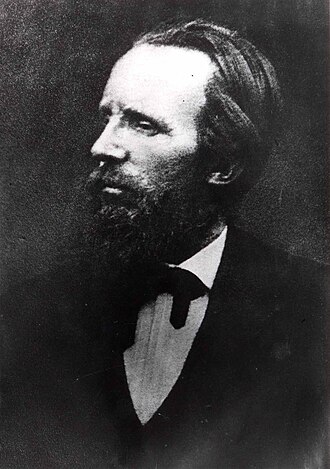 Julius Bahnsen
Julius Bahnsen
Julius Bahnsen
Julius Friedrich August Bahnsen was a German philosopher. Bahnsen is usually considered the originator of characterology and a real-dialectical method of philosophical reflection which he laid down in his two-volume Contributions to Characterology (1867) and developed forth with his following works, amongst others his magnum opus The Contradiction in the Knowledge and Being of the World (1880/82).
"[The self is divided within itself], willing what it does not will and not willing what it wills."
Julius Bahnsen"The conclusion of the Realdialektik is: It does not suffice either for complete annihilation or for full satisfaction. The child of Gaia is born between heaven and hell, now ready to camp with the lightshunning creatures of the Chthonic darkness, now ready to flutter upwards to the heights of splendor."
Julius Bahnsen"Man is a self-conscious Nothing."
Julius Bahnsen"And if my friends refused to listen to me, then the walls had to hear me or the stones in the fields and the trees of the forests."
Julius Bahnsen"[On Hegels panlogism offers] no asylum for lawless vagabonds (sinners against the logical order), no free playground granted by the master of the world in his good humor to each of these kobolds, where they might have the privilege of moving about and of enjoying themselves in a manner unrelated to the rational worldpurpose-until their day also came and the broomstick of the courtmaster would sweep them out into the sanctum."
Julius Bahnsen"What in all the world has courage to do with hope?"
Julius Bahnsen"The greatest pain of all, Bahnsen maintains, comes from the death of a loved one. When we lose someone we cherish, someone in whom we have invested all our heart, we are shattered into a thousand pieces; our inner world is filled with “the infinity of nothingness". The most desolate emptiness of them all is “the dark feeling of loneliness” that comes with the loss of our nearest and dearest. In a world without providence, redemption or immortality, this loss is complete, eternal and irredeemable. There cannot be any comfort, there cannot be any compensation, for the loss. Of course, time heals all wounds; but we fear the dead becoming dead for us, because we know that, should we forget them, we too will be dead in our own best part."
Julius Bahnsen"[On Spinozas necessity of the worlds process:] The inability to resign oneself to the necessary order, is also a necessity and the pain is on that account no less!"
Julius Bahnsen"[On Schopenhauer:] I went away conscious that I had seen not only a genius-of ideas, but also a character of the most genuine sublimity . . I felt myself . . . transported into a new existence. Francis of Assisi and the other heroes of asceticism had become my ideals."
Julius Bahnsen