SHAWORDS
Kapaleeshwarar Temple

Kapaleeshwarar Temple

Kapaleeshwarar Temple

Kapaleeshwarar Temple

author
4Quotes

The Kapaleeshwarar Temple is a Hindu temple dedicated to the god Shiva. It is located in Mylapore, Chennai in the Indian state of Tamil Nadu. The temple was built around the 7th century A.D. and is an example of South Indian Architecture.

Popular Quotes

4 total
Quote
"The best evidence for a Shiva temple on the Mylapore beach is offered by the Tamil saints. Iyadigal Kadavarkon, the sixth century Shaivite prince of Kanchipuram, Jnanasambandar and Arunagirinathar, the sixth and fifteenth century Shaivite poets, consistently mention in their hymns that the Kapaleeswara Temple was on the seashore. Both saints show in these verses that the Lord was on the seashore, and Jnanasambandar marks that He was watching His devotees in the sea – that He must have been facing east. This is not the case today. The seventeenth century Vijayanagar temple is built inland and the Lord faces west, with the all – important flag pole and image of Nandi in the western courtyard before Him. This arrangement indicates that the present temple is a second temple, as the Agama Shastra does not permit a temple that has been moved from its original site and rebuilt to face in the same direction as its predecessor. Neither Jnanasambandar nor Arunagirinathar had reason to sing of the Lord by the sea if He was not there. Their testimony is impeccable and by itself destroys the argument for a seashore tomb of St. Thomas."
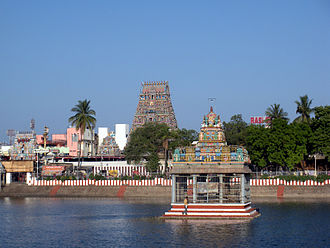
Kapaleeshwarar TempleKapaleeshwarar Temple
Quote
"“Mylapore fell into the hands of the Portuguese in 1566, when the temple suffered demolition. The present temple was rebuilt around three hundred years ago. There are some fragmentary inscriptions from the old temple still found in the St. Thomas Cathedral.” M. Arunachalam also says, “Later, devout Hindus built the present temple of Mylapore at a different site, a few furlongs west, out of whatever they could salvage from the ruins of the old temple. A number of carved temple stones can still be seen on the compound wall of the church.”"
Kapaleeshwarar TempleKapaleeshwarar Temple
Quote
"Poompavai was the daughter of a wealthy sixth century Mylapore merchant called Siva Nesan Chettiar. He wanted to give her in marriage to the saint Jnanasambandar, but she died from snakebite before meeting him, when picking flowers for the Lord in the garden. Her father cremated her and kept the bones and ashes in a pot. When Jnanasambandar visited Mylapore, the Chettiar kept Poompavai’s ashes in front of him and narrated the story of her death. Jnanasambandar responded by singing eleven songs in praise of Lord Kapaleeswara, lamenting the death of the girl at the end of each song. When he had finished, the pot of ashes burst and a twelve-year-old girl stepped forth. Jnanasambandar then declined to marry her, saying that she was his “daughter”. Poompavai has her own shrine within the precincts of the Kapaleeswara Temple."
Kapaleeshwarar TempleKapaleeshwarar Temple
Quote
"“The first Portuguese historians say ... that St. Thomas built his ‘house’, meaning his church, on the site where a Jogi had his temple.” ... “Fragmentary Tamil inscription of eight lines on a stone found at the cathedral, northwest end of the veranda, on the top line of the granite foundations of walls projecting from the veranda into the garden. “When I visited Mylapore last February, 1924, the stone was still lying near the place of the find. It ought to go to the Bishop’s Museum and receive an appropriate number. “According to the Assistant Archaeological Superintendent of Epigraphs, Madras, this inscription is a fragment in Tamil and it seems to register a tax-free gift for burning at night a lamp before the image of Kuttaduvar (Nataraja) in the temple of Suramudaiyar. Palaeographically this inscription may be assigned to the 11th century A.D. “A later communication from the Government Epigraphist for India, Fernhill, Nilgiris, says that Mr. Venkoba Rao, the Assistant Archaeological Superintendent for Epigraphy, Madras, pronounces the inscription belongs to Vikrama Chola’s time (12th century) and that the gift was to the Hindu god Nataraja, whose shrine is always to be seen in a Siva temple. “The stone was not found at its original site, as is shown by its fragmentary condition, the parts above and below, as well as right and left, being wanting. All we can gather is that the foundations in which the stone was inserted are of a date later than the inscription. To argue, as was done at the time of discovery in the Madras Mail, that, if the stone was dug up from any depth, it would indicate an original Saiva temple, on the ruins of which the Portuguese church of modern St. Thomas was erected, is to show a lamentable ignorance of what Marco Polo and even earlier writers have written about St. Thomas.”"
Kapaleeshwarar TempleKapaleeshwarar Temple

Similar Authors & Thinkers



