Quote
"There are many reasons there was higher inflation in the 1970s. But that is a complicated story that deals with much more than tax policies."
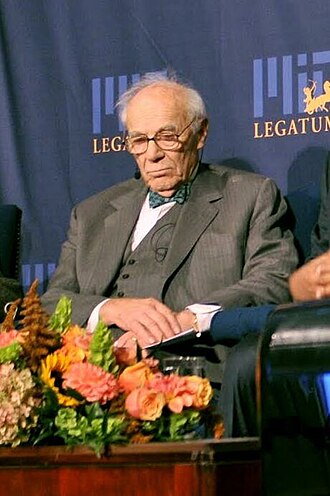 Lawrence Klein
Lawrence Klein
Lawrence Klein
Lawrence Robert Klein was an American economist. For his work in creating computer models to forecast economic trends in the field of econometrics in the Department of Economics at the University of Pennsylvania, he was awarded the Nobel Memorial Prize in Economic Sciences in 1980 specifically "for the creation of econometric models and their application to the analysis of economic fluctuations an
"There are many reasons there was higher inflation in the 1970s. But that is a complicated story that deals with much more than tax policies."
Lawrence Klein"The centrally planned economics used to consider themselves well insulated against the economic ills of the rest of the world. This is no longer the case."
Lawrence Klein"I believe that monetary policy has a chronic defect. It is asymmetric—it works better in restraining an economy than in stimulating an economy."
Lawrence Klein"Although I was not aware of it at the time, the experience of growing up during the Great Depression was to have a profound impact on my intellectual and professional career."
Lawrence Klein"In the past few years there has grown up a large group of young economists who have accepted the theoretical doctrines of the Keynesian Revolution and who have come into national prominence through their support of an economic policy of full employment."
Lawrence Klein"People say monetary policy is easy and quick to implement. It can even be done overnight on the telephone, they say fiscal policy drags out in political and congressional debate in our country. It might take months to implement. But the point is that once fiscal policy is implemented, it might go to work much faster than monetary policy."
Lawrence Klein"I think the Kennedy-Johnson tax cut was a marvelous success in 1964. It was too bad it was not implemented a little sooner, and Kennedy died, of course. After that, Johnson dallied for a while about raising taxes to pay for the war in Vietnam. The stimulus did not get reversed until the tax increase and expenditure cap of 1969, and that had a quick effect once it was enacted. As you know, we had a recession in 1969–1970."
Lawrence Klein"At Chicago, I was in the midst of a veritable galaxy of stars: Trygve Haavelmo, Tjalling Koopmans, Theodore Anderson, Leonid Hurwicz, Herman Rubin, Kenneth Arrow, , , and Herbert Simon, among others. I completed my first of a series of macroeconometric models, solidified my understanding of econometrics, learned (through endless discussion) about the functioning of the economy, and got started on several theoretical paths such as aggregation, demand systems, and prediction."
Lawrence Klein"Balancing fiscal and monetary policies is a problem. If you do just one thing, it is not necessarily enough—neither monetary policy alone nor fiscal policy alone, and neither tax cuts nor expenditure increases alone. You need to mix policy. By having the right balance, you can get high employment and stable prices."
Lawrence Klein"It is my firm belief that the only satisfactory test of economics is the ability to predict, and in crucial predictive situations such as reconversion after World War II, the settlement of the Korean War, the settlement of the Vietnam War, the abrupt economic policy switch of the Nixon Administration in August 1972, the oil shock of 1973 (forecast of a world-wide succession by LINK), the recession of 1990. In these crucial periods, econometric models outperformed other approaches, yet there is considerable room for improvement, and that is precisely what is being examined in development of high-frequency models that aim to forecast the economy, every week, every fortnight, or every month, depending on the degree of fineness of the information flow."
Lawrence Klein"The basic point is that economies are very complex — there are millions of actors — and to understand how they will respond to some change is extremely challenging,” says n. “His contribution, building in part on the work of others, was developing a manageable way of representing economies and how they would change with different kinds of policy changes.”"
Lawrence Klein"The centrally planned economies, dissatisfied with the outcome of their own efforts to achieve good economic growth performance, have changed strategy and decided to import high technology from the West. as well as necessary grains to supplement their domestic agicultural supplies. This new approach has opened their economies to Western inflation because imports have been reflecting rising world price. Gold and oil sales at correspondingly rising prices have been used by the Soviet Union to finance part of their import needs. but they are fully enmeshed in world inflation accounting in balancing rising export prices."
Lawrence Klein




