SHAWORDS
Manhattan Project

Manhattan Project

Manhattan Project

Manhattan Project

author
6Quotes

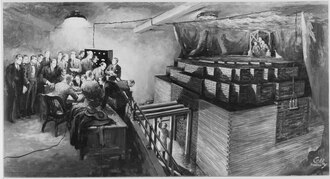
The Manhattan Project was a research and development program undertaken during World War II to produce the first nuclear weapons. It was led by the United States in collaboration with the United Kingdom and Canada. The Manhattan Project employed nearly 130,000 people at its peak and cost nearly US$2 billion.

Popular Quotes

6 total
Quote
"Five years ago, the idea of Atomic Power was only a dream. You have made that dream a reality. You have seized upon the most nebulous of ideas and translated them into actualities. You have built cities where none were known before. You have constructed industrial plants of a magnitude and to a precision heretofore deemed impossible. You built the weapon which ended the War and thereby saved countless American lives. With regard to peacetime applications, you have raised the curtain on vistas of a new world."
Manhattan ProjectManhattan Project
Quote
"Culture, technology and war are so interdependent that it is hard to say which drives which. War pushes ahead the development of technology but it also adapts what is already there. The ancient world used levers for their wine and olive presses; the Romans adapted those to hurl stones against enemy soldiers, ships and fortifications. In the Middle Ages craftsmen learned how to make high-quality metal for casting church bells and that then helped in the making of better guns. In the nineteenth century the Swedish chemist and businessman Alfred Nobel invented dynamite for use in mining; it was rapidly adapted to produce a whole range of increasingly effective guns. Farmers in America used barbed wire to pen in their cattle; strung out in front of the trenches in the First World War, it contributed greatly to the power of the defence. The tank incorporated the caterpillar treads which had been developed for tractors. Albert Einstein and his fellow physicists had worked out the theory of how to split the atom, proving on paper that doing so would release a huge surge of energy, but no way of finally testing that hypothesis existed until the Second World War. In their search for victory in the monumental struggle against their enemies, the British and, in particular, the Americans found the resources to refine the necessary uranium and to build and test the first successful bomb. The Manhattan Project, it is estimated, cost over $20 billion, not far short of what the United States spent on all its small arms over the duration of the war"
Manhattan ProjectManhattan Project
Quote
"Despite their revolutionary character those bombs were built under an old and familiar set of assumptions: that if they worked, they would be used. Few of the thousands of people employed in the wartime Manhattan Project saw their jobs as differing from the design and production of conventional weapons. Atomic bombs were meant to be dropped, as soon as they were ready, on whatever enemy targets yet remained. Technology might have changed, but the human habit of escalating violence had not. The bombs builders would have been surprised to learn, therefore, that the first military uses of nuclear weapons, on August 6 and 9, 1945, would be the last for the rest of the 20th century. As the means of fighting great wars became exponentially more devastating, the likelihood of such wars diminished, and ultimately disappeared altogether. Contrary to the lesson Thucydides drew from the greatest war of his time, human nature did change—and the shock of Hiroshima and Nagasaki began the process by which it did so."
Manhattan ProjectManhattan Project
Quote
"Much, I imagined, like members of a religious order would, I shared with my colleagues a sense of brotherhood, living and working with others for a transcendent cause. In fact, those former Manhattan Project scientists who stayed on in weapons work, as well as their successors at the nuclear weapons labs, are often described by others (not admiringly) as a secular priesthood. In part that’s a matter of their knowledge of secrets of the universe, arcana not to be shared with the laity: the sense of being an insider, the seductions of secrecy, to be counseling men of power. An article on the new “military intellectuals” likened RAND consultants in Washington and the Pentagon, moving invisibly across bureaucratic boundaries opaque to others, to the Jesuits of old Europe, moving between courts, serving as confessors to kings. But above all, precisely in my early missile-gap years at RAND and as a consultant in Washington, there was our sense of mission, the burden of believing we knew more about the dangers ahead, and what might be done about them, than did the generals in the Pentagon or SAC, or Congress or the public, or even the president. It was an enlivening burden."
Manhattan ProjectManhattan Project

Similar Authors & Thinkers



