SHAWORDS
Marxism–Leninism

Marxism–Leninism

Marxism–Leninism

Marxism–Leninism

author
10Quotes

Marxism–Leninism is a form of communist ideology that became the largest faction of the communist movement in the world in the years following the October Revolution. It was the predominant ideology of most communist governments throughout the 20th century. It was developed in the Soviet Union by Joseph Stalin and drew on elements of Bolshevism, Leninism, and Marxism. It was the state ideology of

Popular Quotes

10 total
Quote
"Meanwhile, communism had promised a better life but failed to deliver. Marx insisted that the shifts in the means of production would increase inequality, provoke anger, and thereby fuel revolutionary consciousness within the "working class." He failed, though, to anticipate the kinds of shifts that would take place, for as post-industrial economies evolved they began to reward lateral over hierarchical forms of organization. Complexity made planning less feasible than under the earlier, simpler stages of industrialization: only decentralized, largely spontaneous markets could make the millions of decisions that had to be made each day in a modern economy if supplies of goods and services were to match demands for them. As a result, dissatisfaction with capitalism never reached the point at which "proletarians of all countries" felt it necessary to unite to throw off their "chains." That became clear during the Cold War, and it did so largely because western leaders disproved Marxs indictment of capitalism as elevating greed above all else. When set against the perversions of Marxism inflicted by Lenin and Stalin on the Soviet Union and by Mao on China—placing a ruling party and an authoritarian state in control of what was supposed to have been an automatic process of historical evolution—the effect was to discredit communism not just on economic grounds, but also because of its failure to bring about political and social justice. Just as a new world war did not come, so the anticipated world revolution did not arrive. The Cold War had produced yet another historical anachronism."
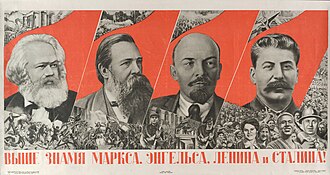
Marxism–LeninismMarxism–Leninism
Quote
"Marxist-Leninist states have perpetuated authoritarian institutions (the secret police, labor bosses, and the communist party) to maintain their power. The apparent effectiveness of such organizations (we‘re just as efficient as the Capitalists) masks the way that “revolutionaries” who pattern themselves after Capitalist institutions become absorbed by bourgeois values, and completely isolated from the real needs and desires of ordinary people. The reluctance of Marxist-Leninists to accept to accept revolutionary social change is, however, above all seen in Lenin’s conception of the party. It is a prescription to just nakedly seize power and put it in the hands of the Communist Party. The party that Leninists create today, they believe, should become the (only) “Party of the Proletariat” in which that class could organize and seize power. In practice, however, this meant personal and party dictatorship, which they felt gave them the right and duty to wipe out all other parties and . Both Lenin and Stalin killed millions or workers and peasants, their left-wing ideological opponents, and even members of the Bolshevik party. This bloody and treacherous history is why them is so much rivalry and hostility between Marxist-Leninist and Trotskyite parties today, and it is why the “workers’ states,” whether in Cuba, China, Vietnam, or Korea are such oppressive bureaucracies over their people. It is also why most of the East European Stalinist countries had their government overthrown by the and ordinary citizens in the 1980s. Maybe we are witnessing the eclipse of State communism entirely, since they have nothing new to say and will never get those governments-back again."
Marxism–LeninismMarxism–Leninism
Quote
"Although the term owed its origins to Italian fascism, the first truly totalitarian regime had been in existence for more than a decade when the Depression struck. By crippling the American colossus for a decade and laying waste to its trading partners and debtors, the economic crisis seemed to vindicate the Soviet model. For, if Marxism-Leninism stood for anything, it was the prediction that capitalism would collapse under the weight of its own contradictions. Now it seemed to be doing precisely that. Understandably, the more the American dream turned to nightmare, the more people were attracted to the Russian alternative of a planned economy - insulated from the vagaries of the market, yet capable of feats of construction every bit as awesome as the skyscrapers of New York or the mass-produced cars of Henry Ford. All the totalitarian state asked in return was complete control of every aspect of life. Only in your dreams were you free from its intrusion, and even there the omnipresent demigod figure of the Leader was liable to intrude. The justification for this abolition of individual freedom was equality: from each according to his abilities, to each according to his needs, as the slogan put it. The aim was not just rapid industrialization; it was the liquidation of the bourgeoisie and other property-owning classes. Yet, as George Orwell would later observe, on the Soviet Animal Farm some animals turned out to be more equal than others. It did not take long for a new class (as the dissident Yugoslav Milovan Djilas later called it) to spring up, composed of the elite functionaries of the totalitarian state. Their control over every aspect of economic life and their freedom from any kind of independent scrutiny or popular accountability made it easy to justify and pay for a whole range of Party privileges; the nomenklatura were also in position to enrich themselves unofficially through peculation and corruption."
Marxism–LeninismMarxism–Leninism
Quote
"For the first two years at the psychology department, Arutyunyan was in hell. Endless hours were devoted to a subject called Marxist-Leninist Philosophy. This was a clear case of propaganda masquerading as scholarship, and while the young Arutyunyan might not necessarily have phrased it this way, she cracked the propaganda code. She developed a simple matrix on which any philosophy could be placed and easily appraised. The matrix consisted of two axes on a cross. One ran from Materialism (good) to Idealism (bad) and the other from Dialectics (good) to Metaphysics (bad). The result was four quadrants. Philosophers who landed in the lower left quadrant, where Metaphysics met Idealism, were all bad. Kant was an example. Someone like Hegel—Dialectics meets Idealism—was better, but not all good. Philosophical perfection resided in the upper-right-hand corner of the graph, at the pinnacle of Dialectical Materialism. Arutyunyan shared this matrix with several classmates, and now they had Marxist-Leninist Philosophy down."
Marxism–LeninismMarxism–Leninism

Similar Authors & Thinkers



