Quote
"Scientific number, being set over such things as these, should be harmoniously constituted, in accordance with itself; not by any other but by itself."
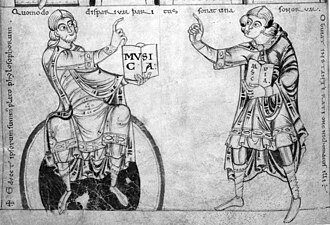 Nicomachus
Nicomachus
Nicomachus
Nicomachus of Gerasa was an Ancient Greek Neopythagorean philosopher from Gerasa, in the Arabia Petraea. He is perhaps Hellenized of Arab origin from Jerash. Like many Pythagoreans, Nicomachus wrote about the mystical properties of numbers, best known for his works Introduction to Arithmetic and Manual of Harmonics, which are an important resource on Ancient Greek mathematics and Ancient Greek mus
"Scientific number, being set over such things as these, should be harmoniously constituted, in accordance with itself; not by any other but by itself."
Nicomachus"Boetius wrote mathematical texts which were considered authoritative in the Western world for more than a thousand years. ...His "institutio arithmetica," a superficial translation of Nicomachus, did provide some Pythagorean number theory which was absorbed in medieval instruction as part of the ancient and : arithmetic, geometry, astronomy, and music."
Nicomachus"Arithmetic Introduction" is the most complete exposition extant of Pythagorean arithmetic. It deals in great part with the same subjects as the arithmetical books of Euclids "Elements," but where Euclid represents numbers by straight lines, Nicomachus uses arithmetical notation with ordinary language when undetermined numbers are expressed. His treatment of s and s was of influence on medieval arithmetic, especially through Boetius."
Nicomachus"Two other sciences in the same way will accurately treat of size: geometry, the part that abides and is at rest, [and] astronomy, that which moves and revolves."
Nicomachus"To quote the words of Timaeus, in Plato, "What is that which always is, and has no birth, and what is that which is always becoming but never is? The one is apprehended by the mental processes, with reasoning, and is ever the same; the other can be guessed at by opinion in company with unreasoning sense, a thing which becomes and passes away, but never really is." Therefore, if we crave for the goal which is worthy and fitting for man, namely happiness of life—and this is accomplished by philosophy alone and nothing else, and philosophy means... for us desire for wisdom, and wisdom the science of the truth of things... it is reasonable and most necessary to distinguish and systematize the accidental qualities of things."
Nicomachus"Number is limited multitude or a combination of units or a flow of quantity made up of units; and the first division of number is even and odd."
Nicomachus"Some... agreeing with , believe that the proportion is called harmonic because it attends upon all geometric harmony, and they say that geometric harmony is the cube because it is harmonized in all three dimensions, being the product of a number thrice multiplied together. For in every cube this proportion is mirrored; there are in every cube 12 sides, 8 angles and 6 faces; hence 8, the [harmonic] mean between 6 and 12, is according to harmonic proportion..."
Nicomachus"Every number is at once half the sum of the two on either side of itself..."
Nicomachus"The even is that which can be divided into two equal parts without a unit intervening in the middle; and the odd is that which cannot..."
Nicomachus"A Jew, Nicomachus, of Gerasa, published an Arithmetic, which, or rather a Latin translation of it) remained for a thousand years a standard authority on the subject. Geometrical demonstrations are here abandoned, and the work is a mere classification of the results then known, with numerical illustrations: the evidence of the truth of the propositions enunciated, for I cannot call them proofs, being in general an induction from numerical instances. The object of the book is the study of the properties of numbers, and particularly of their ratios. Nicomachus commences with the usual distinctions between even, odd, prime, and perfect numbers; he next discusses fractions in a somewhat clumsy manner; he then turns to polygonal and to solid numbers; and finally treats of ratio, proportion, and progressions. Arithmetic of this kind is usually termed Boethian, and the work of Boethius on it was a recognised text-book in the middle ages."
Nicomachus"And once more is this true in the case of music; not only because the absolute is prior to the relative, as great to greater and rich to richer and man to father, but also because the musical harmonies, diatessaron, diapente, and diapason, are named for numbers; similarly all of their harmonic ratios are arithmetical ones, for the diatessaron [] is the ratio of 4 : 3, the diapente [] that of 3 : 2, and the diapason [perfect ] the double ratio [2 : 1]; and the most perfect, the di-diapason [], is the quadruple ratio [4 : 1]."
Nicomachus"The ancients, who under the leadership of Pythagoras first made science systematic, defined philosophy as the love of wisdom... [Οἱ παλαιοὶ καὶ πρώτοι μεθοδεύσαντες ἐπιστήμην κατάρξαντος Πυθαγόρου ὡρίζοντο φιλοσοφίαν εἶναι φιλίαν σοφίας...] This wisdom he defined as the knowledge, or science, of the truth in real things, conceiving science to be a steadfast and firm apprehension of the underlying substance. and real things to be those which continue uniformly and the same in the universe and never depart even briefly from their existence; these real things would be things immaterial..."
Nicomachus