Quote
"As if his whole vocation Were endless imitation."
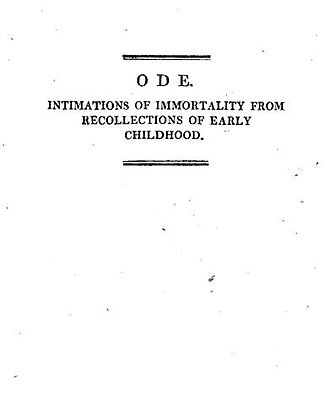 Ode: Intimations of Immortality
Ode: Intimations of Immortality
Ode: Intimations of Immortality
"Ode: Intimations of Immortality from Recollections of Early Childhood" is a poem by William Wordsworth, completed in 1804 and published in Poems, in Two Volumes (1807). The poem was completed in two parts, with the first four stanzas written among a series of poems composed in 1802 about childhood. The first part of the poem was completed on 27 March 1802 and a copy was provided to Wordsworth's f
"As if his whole vocation Were endless imitation."
Ode: Intimations of Immortality"There was a time when meadow, grove, and stream, The Earth, and every common sight, To me did seem Apparelled in celestial light, The glory and the freshness of a dream. It is not now as it hath been of yore— Turn wheresoeer I may, By night or day, The things which I have seen I now can see no more."
Ode: Intimations of Immortality"Whither is fled the visionary gleam? Where is it now, the glory and the dream?"
Ode: Intimations of Immortality"Our birth is but a sleep and a forgetting: The Soul that rises with us, our lifes Star, Hath had elsewhere its setting, And cometh from afar: Not in entire forgetfulness, And not in utter nakedness, But trailing clouds of glory do we come From God, who is our home: Heaven lies about us in our infancy! Shades of the prison-house begin to close Upon the growing boy."
Ode: Intimations of Immortality"The Rainbow comes and goes, And lovely is the Rose, The Moon doth with delight Look round her when the heavens are bare; Waters on a starry night Are beautiful and fair; The sunshine is a glorious birth; But yet I know, whereer I go, That there hath past away a glory from the earth."
Ode: Intimations of Immortality"Ye blessed Creatures, I have heard the call Ye to each other make; I see The heavens laugh with you in your jubilee; My heart is at your festival, My head hath its coronal, The fulness of your bliss, I feel— I feel it all. Oh evil day! if I were sullen While the Earth herself is adorning, This sweet May-morning."
Ode: Intimations of Immortality"The youth, who daily farther from the east Must travel, still is Natures priest, And by the vision splendid Is on his way attended; At length the man perceives it die away, And fade into the light of common day."
Ode: Intimations of Immortality"O joy! that in our embers Is something that doth live, That nature yet remembers What was so fugitive! The thought of our past years in me doth breed Perpetual benediction: not indeed For that which is most worthy to be blest; Delight and liberty, the simple creed Of Childhood, whether busy or at rest, With new-fledged hope still fluttering in his breast:— Not for these I raise The song of thanks and praise; But for those obstinate questionings Of sense and outward things, Fallings from us, vanishings; Blank misgivings of a Creature Moving about in worlds not realised, High instincts before which our mortal Nature Did tremble like a guilty Thing surprised: But for those first affections, Those shadowy recollections, Which, be they what they may, Are yet the fountain-light of all our day, Are yet a master-light of all our seeing; Uphold us, cherish, and have power to make Our noisy years seem moments in the being Of the eternal Silence: truths that wake, To perish never; Which neither listlessness, nor mad endeavor, Nor Man nor Boy, Nor all that is at enmity with joy, Can utterly abolish or destroy!"
Ode: Intimations of Immortality"Thou, whose exterior semblance doth belie Thy Souls immensity; Thou best Philosopher, who yet dost keep Thy heritage, thou Eye among the blind, That, deaf and silent, readst the eternal deep, Haunted for ever by the eternal mind,— Mighty Prophet! Seer blest! On whom those truths do rest, Which we are toiling all our lives to find, In darkness lost, the darkness of the grave."
Ode: Intimations of Immortality"Then sing, ye Birds, sing, sing a joyous song! And let the young Lambs bound As to the tabors sound! We in thought will join your throng, Ye that pipe and ye that play, Ye that through your hearts today Feel the gladness of the May! What though the radiance which was once so bright Be now forever taken from my sight, Though nothing can bring back the hour Of splendour in the grass, of glory in the flower; We will grieve not, rather find Strength in what remains behind; In the primal sympathy Which having been must ever be; In the soothing thoughts that spring Out of human suffering; In the faith that looks through death, In years that bring the philosophic mind."
Ode: Intimations of Immortality"And O, ye Fountains, Meadows, Hills, and Groves, Forebode not any severing of our loves! Yet in my heart of hearts I feel your might; I only have relinquished one delight To live beneath your more habitual sway. I love the Brooks which down their channels fret, Even more than when I tripped lightly as they; The innocent brightness of a new-born Day Is lovely yet; The Clouds that gather round the setting sun Do take a sober colouring from an eye That hath kept watch oer mans mortality; Another race hath been, and other palms are won. Thanks to the human heart by which we live, Thanks to its tenderness, its joys, and fears, To me the meanest flower that blows can give Thoughts that do often lie too deep for tears."
Ode: Intimations of Immortality




