Quote
"The Bases of the New Creation and the Reasons Why It Is Misunderstood."
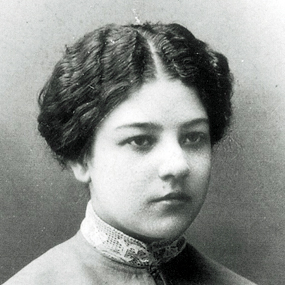 Olga Rozanova
Olga Rozanova
Olga Rozanova
Olga Vladimirovna Rozanova was a Russian avant-garde artist painting in the styles of Suprematism, Neo-Primitivism, and Cubo-Futurism.
"The Bases of the New Creation and the Reasons Why It Is Misunderstood."
Olga Rozanova"Closely examining Rozanovas Suprematist period, we see that Rozanovas Suprematism is contrary to that of Kazimir Malevich, who constructs his works from a composition of quadrate forms, while Rozanova constructs hers from color. For Malevich, color exists solely to distinguish one plane from another; for Rozanova, the composition serves to reveal all the possibilities of color on a plane. In Suprematism, she offered a Suprematism of painting, not of the square [referring to Malevich]."
Olga Rozanova"Opponents of the New Art fall back on this calculation, rejecting its self-sufficient meaning and, having declared it Transitional, being unable even to understand properly the conception of this Art, lumping together Cubism, Futurism, and other phenomena of artistic life, not ascertaining for themselves either their essential differences or the shared tenets that link them."
Olga Rozanova"Only the absence of honesty and of a true love of art provides some artists with the affrontery to live on stale cans of artistic economics stocked up for years, and, year in year out, until they are fifty, to mutter about what they had first started to talk about when they were twenty."
Olga Rozanova"Principles heretofore unknown, signifying the emergence of a new era in creative work - an era of purely artistic achievements. An era of the final emancipation of the Great Art of Painting from Literary, Social, and crudely everyday attributes uncharacteristic of it at its core. The elaboration of this valuable world outlook is the service of our times, irrespective of idle speculation about how quickly the individual trends created by it will flash by."
Olga Rozanova"Rozanova was well aware of Italian Futurism, although unlike Exter, she did not travel in Italy.. .In her careful application of the Italian Futurist evocation of mechanical speed, explosivity, and mobility, Rozanova followed the same path as Malevich (as in his Knife-Grinder, 1912;) and Kliun (as in his Ozonator, 1913—14), and her concurrent writings suggest, she regarded Futurism to be a key phase in the artistic evolution toward Suprematism. Rozanova expressed this impulse not only in her vivid, dynamic paintings, but also in what Yurii Annenkov described as the black plumes of her drawing."
Olga Rozanova




