Quote
"To be a good patriot, a man must consider his countrymen as Gods creatures, and himself as accountable for his acting towards them."
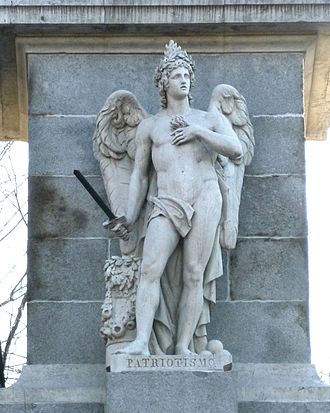 Patriotism
Patriotism
Patriotism
Patriotism is the feeling of love, devotion, and a sense of attachment to one's country or state. This attachment can be a combination of different feelings for things such as the language of one's homeland, and its ethnic, cultural, political, or historical aspects. It may encompass a set of concepts closely related to nationalism, mostly civic nationalism and sometimes cultural nationalism.
"To be a good patriot, a man must consider his countrymen as Gods creatures, and himself as accountable for his acting towards them."
Patriotism"We Americans claim to be a peace-loving people. We hate bloodshed; we are opposed to violence. Yet we go into spasms of joy over the possibility of projecting dynamite bombs from flying machines upon helpless citizens. We are ready to hang, electrocute, or lynch anyone, who, from economic necessity, will risk his own life in the attempt upon that of some industrial magnate. Yet our hearts swell with pride at the thought that America is becoming the most powerful nation on earth, and that she will eventually plant her iron foot on the necks of all other nations. Such is the logic of patriotism."
Patriotism"The shift in emphasis is related to popular notions of "independence", patriotism, and the Englishmans "birthright". The Gordon Rioters of 1780 and the "Church and King" rioters in Birmingham in 1791 had this in common: they felt themselves, in some obscure way, to be defending the "Constitution" against alien elements who threatened their "birthright". They had been taught for so long that the Revolution settlement of 1688, embodied in the Constitution of King, Lords and Commons, was the guarantee of British independence and liberties, that the reflex had been set up — Constitution equals Liberty—upon which the unscrupulous might play. And yet it is likely that the very rioters who destroyed Dr. Priestleys precious library and laboratory were proud to regard themselves as "free-born Englishmen". Patriotism, nationalism, even bigotry and repression, were all clothed in the rhetoric of liberty. Even Old Corruption extolled British liberties; not national honour, or power, but freedom was the coinage of patrician, demagogue and radical alike. In the name of freedom Burke denounced, and Paine championed, the French Revolution: with the opening of the French Wars (1793), patriotism and liberty occupied every poetaster: "Thus Britons guard their ancient fame, Assert their empire oer the sea, And to the envying world proclaims, One nation still is brave and free— Resolvd to conquer or to die, True to their KING, their LAWS, their LIBERTY."
Patriotism"Patriotism has served, at different times, as widely different ends as a razor, which ought to be used to keep your face clean and yet may be used to cut your own throat or that of some more innocent person."
Patriotism"The cheapest sort of pride is national pride; for if a man is proud of his own nation, it argues that he has no qualities of his own of which he can be proud; otherwise he would not have recourse to those which he shares with so many millions of his fellowmen. The man who is endowed with important personal qualities will be only too ready to see clearly in what respects his own nation falls short, since their failings will be constantly before his eyes. But every miserable fool who has nothing at all of which he can be proud adopts, as a last resource, pride in the nation to which he belongs; he is ready and glad to defend all its faults and follies tooth and nail, thus reimbursing himself for his own inferiority."
Patriotism"No one loves his country for its size or eminence, but because it is his own."
Patriotism"The Protestant way of reconciling the commandments of Christ with those human activities that appealed to them was to declare any reconciliation to be impossible. … We must love our enemies. But whether this means burning the heretic and the witch, sending children to work before they can read, making bombs and blessing them, or whether it means the opposite, each believer has to decide for himself without even suspecting what the true will of God might be. A guiding light, though a deceptive one, is provided by the interest of the fatherland, of which there is little mention in the Gospels. In the last few centuries, an incomparably greater number of believers have staked their lives for their country than for the forbidden love of its enemies. The idealists from Fichte to Hegel have also taken an active part in this development. In Europe, faith in God has now become faith in one’s own people. The motto, “Right or wrong, my country,” together with the tolerance of other religions with similar views, takes us back into that ancient world from which the primitive Christians had turned away."
Patriotism"If patriotism is good, then Christianity, which gives peace, is an idle dream, and the sooner this teaching is eradicated, the better. But if Christianity really gives peace, and if we really want peace, then patriotism is a leftover from barbarous times, which must not only not be evoked and taught, as we now do, but which must be eradicated by all means of preaching, persuasion, contempt, and ridicule. If Christianity is the truth, and if we wish to live in peace, then we must not only have no sympathy for the power of our country, but must even rejoice in its weakening and contribute to it."
Patriotism"I have already several times expressed the thought that in our day the feeling of patriotism is an unnatural, irrational, and harmful feeling, and a cause of a great part of the ills from which mankind is suffering, and that, consequently, this feeling – should not be cultivated, as is now being done, but should, on the contrary, be suppressed and eradicated by all means available to rational men. Yet, strange to say – though it is undeniable that the universal armaments and destructive wars which are ruining the peoples result from that one feeling – all my arguments showing the backwardness, anachronism, and harmfulness of patriotism have been met, and are still met, either by silence, by intentional misinterpretation, or by a strange unvarying reply to the effect that only bad patriotism (Jingoism or Chauvinism) is evil, but that real good patriotism is a very elevated moral feeling, to condemn which is not only irrational but wicked. What this real, good patriotism consists in, we are never told; or, if anything is said about it, instead of explanation we get declamatory, inflated phrases, or, finally, some other conception is substituted for patriotism – something which has nothing in common with the patriotism we all know, and from the results of which we all suffer so severely."
Patriotism"Be Briton still to Britain true, Among oursels united; For never but by British hands Maun British wrangs be righted."
Patriotism"I realize that patriotism is not enough. I must have no hatred toward any one."
Patriotism"I was over in Australia, and I was asked, Are you proud to be an American? And I was like, Um, I dont know, I didnt have a lot to do with it. You know, my parents fucked there, thats about all. You know, I was in the spirit realm at that time. "Fuck in Paris! Fuck in Paris!" but they couldnt hear me, cos I didnt have a mouth. I was a spirit without lungs or mouth or vocal cords. They fucked here. OK, Im proud. I hate patriotism. I cant stand it, man. Makes me fuckin sick. Its a round world last time I checked, OK? You know what I mean. I hate patriotism. In fact, thats how we could stop patriotism, I think. Instead of putting stars and stripes on our flags, we should put pictures of our parents fucking."
Patriotism