Quote
"Without a constant misuse of language, there cannot be any discovery, any progress."
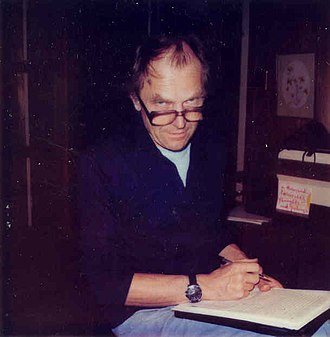 Paul Karl Feyerabend
Paul Karl Feyerabend
Paul Karl Feyerabend
Paul Karl Feyerabend was an Austrian philosopher best known for his work in the philosophy of science. He started his academic career as lecturer in the philosophy of science at the University of Bristol (1955–1958); afterward, he moved to the University of California, Berkeley, where he taught for three decades (1958–1989). At various points in his life, he held joint appointments at the Universi
"Without a constant misuse of language, there cannot be any discovery, any progress."
Paul Karl Feyerabend"Mathematical Reasoning is not only exact; it has its own criteria of reality"
Paul Karl Feyerabend"Science is an essentially anarchic enterprise: theoretical anarchism is more humanitarian and more likely to encourage progress than its law-and-order alternatives."
Paul Karl Feyerabend"[On Empiricism] It is evident, on the basis of our considerations, that this appearance of success cannot in the least be regarded as a sign of truth and correspondence with nature. Quite the contrary, suspicion arises that the absence of major difficulties is a result of the decrease of empirical content brought about by the elimination of alternatives, and of facts that can be discovered with their help. In other words, the suspicion arises that this alleged success is due to the fact that the theory, when extended beyond its starting point, was turned into rigid ideology. Such Ideology is "successful" not because it agrees so well with the facts; it is successful because no facts have been specified that could constitute a test, and because some such facts have been removed. Its "success" is entirely man-made. It was decided to stick to some ideas, come what may, and the result was, quite naturally, the survival of these ideas. If now the initial decision is forgotten, or made only implicitly, for example, if it becomes common law in physics, then the survival itself will seem to constitute independent support., it will reinforce the decision, or turn it into an explicate one, and in this way close the circle. This is how empirical "evidence" may be created by a procedure which quotes as its justification the very same evidence it has Produced."
Paul Karl Feyerabend"Paul Feyerabend was one of the most influential philosophers of science of the twentieth century—unfortunately, I might add. While he was not a postmodernist (he reportedly did believe in an objective reality), his writings have given plenty of ammunition to post-modernists and even the few creationists who know who he was."
Paul Karl Feyerabend"It is true that Popper and Feyerabend differ in many respects. But it is unfair to single out Feyerabend as worse than the others. For he too sets out to do what he sincerely believes is best for society. This he does by declaring "Anything goes", a position that follows inescapably from the (popperian) premise that all observations are theory-laden. This premise is the most basic of all errors, and the writings of those who commit it are bound to be a hopeless muddle. If Popper, Kuhn and their followers do not like being called relativists, negativists and irrationalists, then they ought to repudiate this worst of all antitheses."
Paul Karl Feyerabend"Beneath Feyerabends rhetorical antics lurked a deadly serious theme: the human compulsion to find absolute truths, however noble it may be, often culminates in tyranny. Feyerabend attacked science not because he actually believed it was no more valid than astrology or religion. Quite the contrary. He attacked science because he recognized — and was horrified by — sciences vast superiority to other modes of knowledge. His objections to science were moral and political rather than epistemological. He feared that science, precisely because of its enormous power, could become a totalitarian force that crushes all its rivals."
Paul Karl Feyerabend"It is only fair to admit my limitations and biases in making this judgment. After a few years’ infatuation with philosophy as an undergraduate I became disenchanted. The insights of the philosophers I studied seemed murky and inconsequential compared with the dazzling successes of physics and mathematics. From time to time since then I have tried to read current work on the philosophy of science. Some of it I found to be written in a jargon so impenetrable that I can only think that it aimed at impressing those who confound obscurity with profundity. Some of it was good reading and even witty, like the writings of Wittgenstein and Paul Feyerabend. But only rarely did it seem to me to have anything to do with the work of science as I knew it. According to Feyerabend, the notion of scientific explanation developed by some philosophers of science is so narrow that it is impossible to speak of one theory being explained by another, a view that would leave my generation of particle physicists with nothing to do."
Paul Karl Feyerabend"Today science prevails not because of its comparative merits, but because the show has been rigged in its favour... It reigns supreme because some past successes have led to institutional measures (education; role of experts; role of power groups such as the AMA) that prevent a comeback of the rivals."
Paul Karl Feyerabend"A free society is a society in which all traditions have equal rights and equal access to the centers of power. A tradition receives these rights not because the importance the cash value, as it were) it has for outsiders but because it gives meaning to the lives of those who participate in it."
Paul Karl Feyerabend"One can show the following: given any rule, however "fundamental" or "necessary" for science, there are always circumstances when it is advisable not only to ignore the rule, but to adopt its opposite."
Paul Karl Feyerabend"Science is not sacrosanct. The mere fact that it exists, is admired, has results is not sufficient for making it a measure of excellence. Modern science arose from global objections against earlier views and rationalism itself, the idea that there are general rules and standards for conducting our affairs, affairs of knowledge included, arose from global objections to common sense."
Paul Karl Feyerabend




