Quote
"The real danger from advertising is that it helps to shatter and ultimately destroy our most precious non-material possessions: the confidence in the existence of meaningful purposes of human activity and respect for the integrity of man."
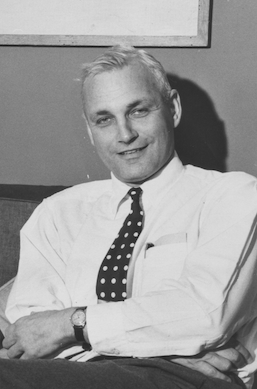
Paul Sweezy
Paul Sweezy


Paul Marlor Sweezy was an American Marxist economist, political activist, publisher, and founding editor of the long-running magazine Monthly Review. He is best remembered for his contributions to economic theory as one of the leading Marxian economists of the second half of the 20th century.
"The real danger from advertising is that it helps to shatter and ultimately destroy our most precious non-material possessions: the confidence in the existence of meaningful purposes of human activity and respect for the integrity of man."
"Society is more than a number of individuals. It is a number of individuals among whom certain definite and more or less stable relations exist."
"It seems obvious that in this way the economist avoids a systematic exploration of those social relations which are so universally regarded as having a relevance to economic problems that they are deeply imbedded in the everyday speech of the business world. And it is even more obvious that the basic point of view which modern economics has adopted unfits it for the larger task of throwing light on the role of the economic element in the complex totality of relations between man and man which make up what we call society."
"The legitimate purpose of abstraction in social science is never to get away from the real world but rather to isolate certain aspects of the real world for intensive investigation."
"Discussions of methodology in economics, as in other fields, are likely to be tiresome and unrewarding. Nevertheless, to avoid the problem altogether is to risk serious misunderstanding."
"It must be emphasized, because the contrary has so often been asserted, that Marx was not trying to reduce everything to economic terms. He was rather attempting to uncover the true interrelation between the economic and the non-economic factors in the totality of social existence."
"It is essential to realize that it was this analysis of the social characteristics of commodity production, and not an arbitrary preconception or an ethical principle, which led Marx to identify labor as the substance of value."
"In possessing use value a commodity is in no way peculiar. Objects of human consumption in every age and in every form of society likewise possess use value. Use value is an expression of a certain relation between the consumer and the object consumed. Political economy, on the other hand, is a social science of the relations between people."
"Capitalist society is characterized by a degree of labor mobility much greater than prevailed in any previous form of society."
"In every society, from the most primitive to the most advanced, it is essential that labor be applied to production and that goods be distributed among the members of society. What changes in the course of history is the way in which these productive and distributive activities are organized and carried out."
"Turning from political economy in a narrow sense, it is apparent that the commodity-producing form constitutes the most effective possible veil over the true class character of capitalist society."
"Supply and demand will be in equilibrium only when the price of every commodity is proportional to the labor time required to produce it. Conversely prices proportional to labor times will be established only if the forces of competitive supply and demand are allowed to work themselves out freely. The competitive supply-and-demand theory of price determination is hence not only not inconsistent with the labor theory; rather it forms an integral, if sometimes unrecognized, part of the labor theory."

