Quote
"La vraie éloquence se moque de léloquence, la vraie morale se moque de la morale."
 Pensées
Pensées
Pensées
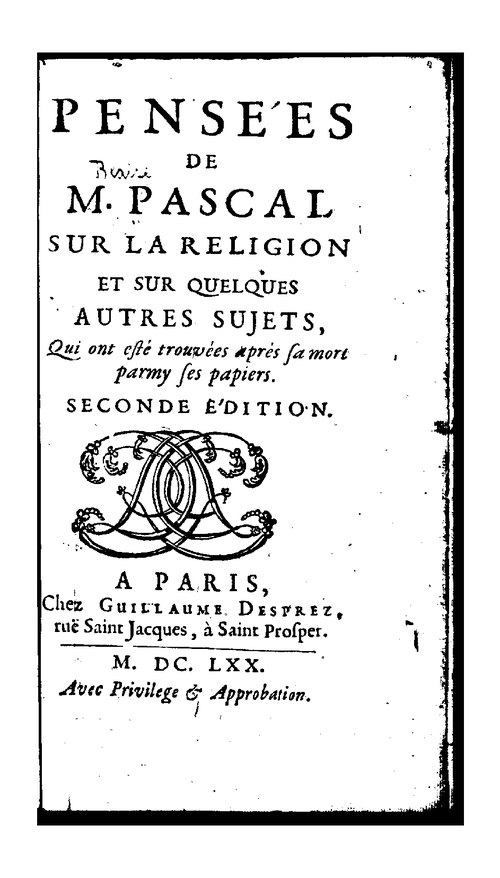
The Pensées (Thoughts) is a collection of fragments written by the French 17th-century philosopher and mathematician Blaise Pascal. Pascal's religious conversion led him into a life of asceticism, and the Pensées was in many ways his life's work. It represented Pascal's defense of the Christian religion, and the concept of "Pascal's wager" stems from a portion of this work.
"La vraie éloquence se moque de léloquence, la vraie morale se moque de la morale."
Pensées"...no one is offended at not seeing everything; but one does not like to be mistaken, and that perhaps arises from the fact that man naturally cannot see everything, and that naturally he cannot err in the side he looks at, since the perceptions of our senses are always true."
Pensées"There are then two kinds of intellect: the one able to penetrate acutely and deeply into the conclusions of given premises, and this is the precise intellect; the other able to comprehend a great number of premises without confusing them, and this is the mathematical intellect. The one has force and exactness, the other comprehension. Now the one quality can exist without the other; the intellect can be strong and narrow, and can also be comprehensive and weak."
Pensées"...we cannot define these things without obscuring them, while we speak of them with all assurance. ...our doubts cannot take away all the clearness, nor our own natural lights chase away all the darkness."
Pensées"Scepticism.—I shall here write my thoughts without order, and not perhaps in unintentional confusion; that is the true order, which will always indicate my object by its very disorder. I should do too much honor to my subject, if I treated it with order, since I want to show that it is incapable of it."
Pensées"...it is to judgment that perception belongs, as science belongs to intellect. Intuition is the part of judgment, mathematics of intellect."
Pensées"Se moquer de la philosophie, cest vraiment philosopher"
Pensées"The greater intellect one has, the more originality one finds in men. Ordinary persons find no difference between men."
Pensées"La dernière chose quon trouve en faisant un ouvrage est de savoir celle quil faut mettre la première."
Pensées"Those who are accustomed to judge by feeling do not understand the process of reasoning, for they would understand at first sight, and are not used to seek for principles. And others, on the contrary, who are accustomed to reason from principles, do not at all understand matters of feeling, seeking principles, and being unable to see at a glance."
Pensées"Rivers are roads which move, and which carry us whither we desire to go."
Pensées"Eloquence is an art of saying things in such a way—(1) that those to whom we speak may listen to them without pain and with pleasure; (2) that they feel themselves interested, so that self-love leads them more willingly to reflection upon it."
Pensées