Quote
"To do nothing now is to let our children lament that they never knew the magnificent diversity of humankind because our generation let disappear those cultures that might have taught it to them."
P
Peter FarbPeter Farb
Peter Farb
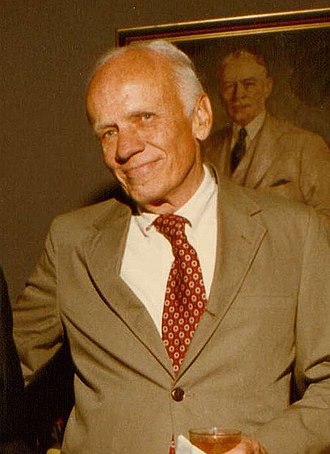
Peter Farb (1929–1980) was an American author, anthropologist, linguist and naturalist.
"To do nothing now is to let our children lament that they never knew the magnificent diversity of humankind because our generation let disappear those cultures that might have taught it to them."
"Perhaps we, who for so long regarded ourselves as bringers of light to the shadowy recesses of North America, will finally admit that there is much about which the Indians can illuminate us."
"In 1830... Joseph Smith... prophesied that a New Jerusalem would arise in the wilds... The Mormons sent emissaries to the Indians, whom he renamed the Lamanites, inviting them to join the Mormon colonies and to be baptized. Joseph Smith was also to have prophesied in 1843 that if he... lived until 1890—the messiah would appear in human form. ...It was in 1890 that... Wovoka appeared and began teaching the [revitalized] Ghost Dance religion."
"...the intensity of the indignation was in direct proportion to a Whites distance from the Indian. On the frontier, the Indian was regarded as a besotted savage; but along the eastern seaboard, where the Spaniards, Dutch, English, and later Americans had long since exterminated all the Indians, philosophers and divines began to defend the Red Man."
"What most impresses the people around the prophet is the personality change he has undergone. ...when stress reaches a certain intensity in the culture, only certain individuals feel called forth to become prophets while most do not. In any event, the prophet has emerged in a new cultural role, and his personality is liberated from the stress that called his response into being in the first place. Immune to the stress under which his brethren still suffer, he must appear to them supernatural."
"At the time of the Europeans discovery of North America, the American Indians already cultivated a wider variety of plants than did the Europeans."
"The desire of Whites to occupy Indian lands, and the constant rivalry between French and English traders for furs gathered by the Indians, led to many skirmishes and several bloody wars, all of which involved Indians on both sides. The Whites were determined to fight it out with each other—down to the last Indian. These battles culminated in the French and Indian War of 1763, which represented a disaster to many Indian groups in the northeastern part of the continent. In May, 1763, an Ottawa warrior by the name of Pontiac fell upon Detroit and captured the English forts, one after the other. Lord Jeffery Amherst... distributed among the Indians handkerchiefs and blankets from the small pox hospital at Fort Pitt—probably the first use of biological warfare in history."
"What makes the Hohokam noteworthy is the development of irrigation works. The earliest... dates from some 2,000 years ago. ...They built dams that redirected the flow of water into irrigation canals, some of them... extending for more than twenty-five miles. ...They built flat-topped pyramids and ball courts, where they used rubber balls imported from Central America. The Hohokam may also have been the first to use the technique of etching with acid in their remarkable designs on marine shells."
"The Shoshone, as well as those peoples around the world who still survive at the least complex levels of social organization, know that romantic love exists. But they also recognize it for what it is—in their case, a form of madness. ...they regard the participants with tolerance and patience, for they know that the illness will soon go away. ...To them, only someone mentally backward would base an institution so important to survival as marriage on romantic love. ...it is a life and death business."
"At various stages of evolution, the Indian cultures were presented with only a limited number of possibilities. The members of certain kinds of societies—the small band, the large band, the tribe, the chiefdom, the state, and variations of these—tended to make characteristic choices concerning religion, law, government, and art... Such choices were not... consciously made... For a particular society, they either worked or they did not work."
"Almost every messianic movement in the world came into being as a result of hallucinatory visions of a prophet. One point must be emphasized about the prophet of a messianic movement: He is not a schizophrenic, as was so long assumed. A schizophrenic with religious paranoia will state that he is God, Jesus, the Great Spirit, or some other supernatural being. The prophet, on the other hand, never states that he is supernatural—only that he has been in contact with supernatural powers. (Of course, after his death, his disciples tend to deify him or at least give him saintly status.)"
"The Puritans failed miserably in their dealings with the Indians of New England, with scarcely a glimmer of kindness to illuminate black page after black page of cruelty and humiliation. ...conversion of the heathen was not one of the compelling motives—or justifications—for the Puritan settling of New England..."