Quote
"Natural order was not invented by the human mind or set up by certain perceptive powers... The existence of order presupposes the existence of organizing intelligence. Such intelligence can be none other than Gods."
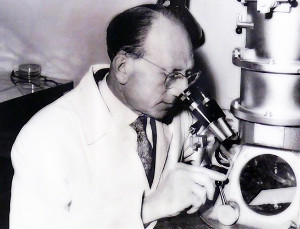 Pierre-Paul Grassé
Pierre-Paul Grassé
Pierre-Paul Grassé
Pierre-Paul Grassé was a French zoologist, writer of over 300 publications including the influential 52-volume Traité de Zoologie. He was an expert on termites who rejected Neo-Darwinism and was a proponent of Neo-Lamarckism.
"Natural order was not invented by the human mind or set up by certain perceptive powers... The existence of order presupposes the existence of organizing intelligence. Such intelligence can be none other than Gods."
Pierre-Paul Grassé"The study of contemporary species does not establish the existence of evolution; it provides facts which support it, but which do not fully demonstrate its existence. This is understandable, since at present we cannot show the series of successive stages which make up evolution, but only a fleeting picture of evolution."
Pierre-Paul Grassé"We have gone from Darwinism into neo-Darwinism, and, very recently, to ultra-Darwinism, which not only claims to be the sole custodian truth in regard to evolution, but to be evolution itself. Darwin himself did not display so much confidence when writing to one of his grandsons... Present-day ultra-Darwinism, which is so sure of itself, impresses incompletely informed biologists, misleads them, and inspires fallacious interpretations. The following is one of the numerous examples found in books today: "In microorganisms, the generation time is rather short and the size of the population can be enormous. Therefore, mutation acts as a very powerful evolutionary process during a shorter lapse of time than in populations of higher organisms"(Levine, 1969, p. 196. the italics are mine) This text suggests that modern bacteria are evolving very quickly, thanks to their innumerable mutations. Now, this is not true. For millions, or even billions of years, bacteria have not transgressed the structural frame within which they have always fluctuated and still do. It is a fact that microbiologists can see in their cultures species of bacteria oscillating around an intermediate form, but this does not mean that two phenomena, which are quite distinct, should be confused; the variation of the genetic code because of a DNA copy error and evolution. To vary and to evolve are two different things; this can never be sufficiently emphasized."
Pierre-Paul Grassé"The mutation of bacteria and viruses are merely hereditary fluctuations around a median position; a swing to the right, a swing to the left, but no final evolutionary effect."
Pierre-Paul Grassé"The philosopher considering the Universe in its entirety is led to admit that there is only one necessary, absolute being, God. All other beings are contingent; this is why Pascal said of himself: "I feel that I might not have been... therefore I am not a necessary being" (Pensées, No. 597). The proposition applies equally to every living thing."
Pierre-Paul Grassé"For those who would still doubt the relevance of our criticisms, another quote from a paper written by two American biologists, King and Jukes (1969), is presented: "Darwinism is so well established that it is difficult to think of evolution except in terms of selection for desirable characteristics and advantageous genes. New technical developments and new knowledge, such as the sequential analysis of proteins and the deciphering of the genetic code, have made a much closer examination of evolutionary processes the sequential analysis of proteins and the deciphering of the genetic code, have made a much closer examination of evolutionary processes possible, and therefore necessary.". These biologists are convinced that the Darwinian credo is correct, and they accept it. They are quite sincere but they are not critical enough. Biochemists and biologists who adhere blindly to the Darwinism theory search for results that will be in agreement with their theories and consequently orient their research in a given direction, whether it be in the field of ecology, ethology, sociology, demography (dynamics of populations), genetics (so-called evolutionary genetics), or paleontology. This intrusion of theories has unfortunate results: it deprives observations and experiments of their objectivity, makes them biased, and, moreover, creates false problems. Heedful of genetics and demography, Darwinians have seldom taken fossils* into consideration, or, and this is more serious, they have applied the laws of genetics to them without making a critical analysis; considering our ignorance of the relationships between fossils, which in most cases are found very far apart and in distinct beds, this approach can only be arbitrary."
Pierre-Paul Grassé"The Darwinians have coined the terms pseudoteleology and teleonomy to designate the finality which they at the same time deny. Appearances are deceptive, they say; the materials of life are always the work of chance. What some take for finality is only the result of the ordering of random materials bynatural selection. Even were this to be true, as it is not, the demon of finility would still not have been exorcized. For natural selection is, in essence and function, the supreme finilizing agent. Actually, the terms pseudoteleology and teleonomy are the homage paid to finality, as hypocrisy pays homage to virtue. Giard (1905), himself a shrewd scholar but blinded by a foolish anticlericalism, went so far as to abjure Lamarckism and write, "To account for the wondrous adaptations such as those we observe between orchids and the insects that fertilize them, we have hardly any choice but the bare alternative hypotheses: the intervention of a sovereignly intelligent being, and selection." He cannot have seriously subjected his supposed dilemma to critical scrutiny or he would have seen that he was substituting for the dethroned divinity just such another, a sorting and finalizing, in sum transcendental, agent, natural selection. Paul Wintrebert, a convinced and even intractable atheist, did not fall into the same trap but realized perfectly that Giards alternative involves, whatever opinion be held, recognizing the intervention of a purposive guiding agent. Giards concept, which is that held by many atheists and "freethinkers", gives a singular and belittling idea of God. The Almighty, obliged to remodel and retouch His own handiwork."
Pierre-Paul Grassé"Exceptional, unforeseeable, or even inexplicable phenomena would hence be fortuitous. these very vague adjectives too often have a merely circumstancial meaning. A given phenomenon, today considered random, may tomorrow be considered determined because its causes will have been unraveled by thorough and specific study. Biologists, whose task is not to seek moral causes or intentions, must first of all make sure that so-called random facts really are random facts; they must constantly keep in mind Poincares (1912b, p. 65) famous phrase: "Chance is only the measure of our ignorance.""
Pierre-Paul Grassé"Here we are, up to our ears in transcendence: Any organization or function is controlled by it. The building blocks for making living creatures are utilized by it. Thus, the entire world of living beings is transcended by phenomena that create finality. Natural selection working for the continuance and welfare of animals, plants, and man himself, is seen to be the grand law which organizes the living universe. So the Darwinians, who fancied they had exorcized finalism and transcendency but forgot to analyze critically the idea of natural selection, failed to see its implications or metaphysical consequences. They thought they were absolved from giving any finalization or deistic interpretation by decreeing that on earth all is but deceptive appearances; finality is a sham, guided evolution illusory. How is it possible to understand such an attitude?"
Pierre-Paul Grassé"When we consider a human work, we believe we know where the "intelligence" which fashioned it comes from; but when a living being is concerned, no one knows or ever knew, neither Darwin nor Epicurus, neither Leibniz nor Aristotle, neither Einstein nor Parmenides. An act of faith is necessary to make us adopt one hypothesis rather than another. Science, which does not accept any credo, or in any case should not, acknowledges its ignorance, its inability to solve this problem which, we are certain, exists and has reality."
Pierre-Paul Grassé"The immanent purpose is an intrinsic property of living beings, without it, they would not exist. Consider the autonomous function units and their components: organs, tissues, isolated cells, as well as other properties such as nutrition, body defense, growth, reproduction, to which they are subject at the end. When it comes to these properties, biologists do not argue; but if you pronounce the word purpose, there is a public outcry. Probably because they do not distinguish the purpose of fact or immanent, the trascendental purpose. Of the latter, the biologist has little or nothing to say; it is a matter of metaphysics."
Pierre-Paul Grassé