Quote
"We arrive at a portrayal of other things, such as the laws governing matter. These are the great generalities – Which do not change."
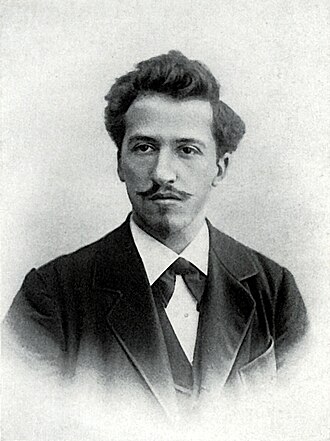 Piet Mondrian
Piet Mondrian
Piet Mondrian
Pieter Cornelis Mondriaan, known after 1911 as Piet Mondrian, was a Dutch painter and art theoretician, who is regarded as one of the greatest artists of the 20th century. He was one of the pioneers of 20th-century abstract art, as he changed his artistic direction from figurative painting to an increasingly abstract style, until he reached a point where his artistic vocabulary was taken down to s
"We arrive at a portrayal of other things, such as the laws governing matter. These are the great generalities – Which do not change."
Piet Mondrian"I often sketched by moonlight {in the 1890s] - cows resting or standing immovable in flat Dutch meadows, or houses with dead, blank windows. I never painted these things romantically, but from the very beginning I was always a realist."
Piet Mondrian"You can so wonderfully be yourself here [in Paris]."
Piet Mondrian"Kandinsky points out [in his book On the Spiritual in Art] that Theosophy (in its true sense; not as it generally appears) is yet another expression of the same spiritual movement which we are now seeing in painting."
Piet Mondrian"In Paris, I quickly mastered the Foxtrot, the Shimmy and the One Step, [he liked the Shimmy best:] At first, the heel-toe was sort of tricky. Nowadays, they find ways around it."
Piet Mondrian"When I first saw the work of the Impressionists, Van Gogh, Van Dongen and the Fauves, I admired it. But I had to seek the true way alone."
Piet Mondrian"The principle of this art [as Mondrian proposes his view on modern art] is not a negation of matter, but a great love of matter, whereby it is seen in the highest, most intense manner possible, and depicted in the artistic creation."
Piet Mondrian"He [ Jan Toorop, an older and famous Dutch religious painter] sees the Catholic faith as A. Besant, [a British Theosophiste and womens right activiste, then] views it in its primeval period: the Catholic religion as it was originally, is the same as Theosophy, is it not? I remained broadly in agreement with Toorop, and I could tell that he goes to the depths, and that he is searching for the spiritual."
Piet Mondrian"The surface of things gives enjoyment, their interiority gives life."
Piet Mondrian"I remained there [in The Netherlands, 1914-18] for the duration of the war, continuing my work of abstraction in a series of church. facades, trees, houses, etc. But I felt that I still worked as an Impressionist and was continuing to express particular feelings, not pure reality. Although I was thoroughly conscious that we can never be absolutely objective, I felt that one can become less and less subjective, until the subjective no longer predominates in ones work. More and more I excluded from my painting all curved lines, until finally my compositions consisted only of vertical and horizontal lines which formed crosses, each separate and detached from the other. Observing sea, sky and stars, I sought to indicate their plastic function through a multiplicity crossing verticals and horizontals."
Piet Mondrian"[I am searching] pure expression of that incomprehensible power, which works universally."
Piet Mondrian"It was during this early period of experiment that I first went to Paris. The time was around 1910 when Cubism was in its beginnings. I admired Matisse, Van Dongen and the other Fauves, but I was immediately drawn to the Cubists, especially to Picasso and Léger. Of all the abstractionists (Kandinsky and the Futurists) I felt that only the Cubists had discovered the right path; and, for a time, I was much influenced by them."
Piet Mondrian




