Quote
"The Portuguese language is beautiful, rich and resounding, less sluggish and hard than German and English, more energic and phonetically diverse than Italian, softer and more natural than Spanish and superior in every aspect to French."
Portuguese language
Portuguese language


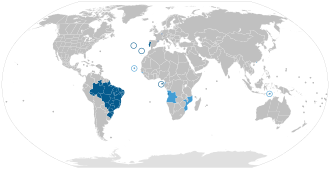
Portuguese is a Western Romance language of the Indo-European language family originating from the Iberian Peninsula of Europe. It is spoken chiefly in Portugal, in Brazil, and in several African countries, as well as by immigrants in North America, Europe, and South America. With approximately 267 million speakers, it is listed as the fifth-most spoken native language.
"The Portuguese language is beautiful, rich and resounding, less sluggish and hard than German and English, more energic and phonetically diverse than Italian, softer and more natural than Spanish and superior in every aspect to French."
"The Portuguese language remained a lingua franca in Bengal as late as the eighteenth century. Clive, who could never give an order in any native language, was said to speak fluent Portuguese. The first three books printed in the Bengali language were printed in Latin characters in Lisbon in 1743, and it was a Portuguese who composed the first Bengali prose work and the first Bengali grammar and dictionary. In Modern Bengali, articles of common use, items used in Christian services, and plants often go by their Portuguese names; e.g., ag-bent (holy water), alpin (pin), altar (altar), ananas (pineapple), balti (bucket), bispa (bishop), botel (bottle), spanj (sponge), girja (church), tamak (tobacco), piyara (pear), ata (custard apple), veranda, etc. Other Portuguese words have passed into the English language, including caste, peon, padre, papaya, plantain, cobra, mosquito, pomfret, and palmyra."
"Knowing English is important, but for us Venezuelans I think it would also be important to know Portuguese. For that reason, we should evaluate the possibility of it being taught in our schools."

