Quote
"(Econometrics is) the unification of economic theory, statistics and mathematics."
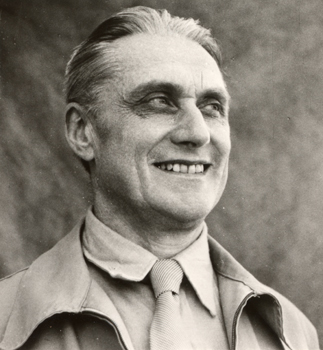 Ragnar Frisch
Ragnar Frisch
Ragnar Frisch
Ragnar Anton Kittil Frisch was an influential Norwegian economist and econometrician known for being one of the major contributors to establishing economics as a quantitative and statistically informed science in the early 20th century. He coined the term econometrics in 1926 for utilising statistical methods to describe economic systems, as well as the terms microeconomics and macroeconomics in 1
"(Econometrics is) the unification of economic theory, statistics and mathematics."
Ragnar Frisch"Deep in the human nature there is an almost irresistible tendency to concentrate physical and mental energy on attempts at solving problems that seem to be unsolvable."
Ragnar Frisch"Ragnar Frisch was an ardent protagonist for more scientific economics in the interwar period and played an active role internationally through his scholarly contributions but also through his efforts for the and its journal , which may be regarded as landmarks both for the scientification and the internationalization of economics. For many years Frisch was the only Norwegian economist of international renown and became a father figure for Norwegian economics."
Ragnar Frisch"[The] length of the cycles and the tendency towards dampening are determined by the intrinsic structure of the swinging system, while the intensity (the amplitude) of the fluctuations is determined primarily by the exterior impulse. An important consequence of this is that a more or less regular fluctuation may be be produced by a cause which operates irregularly."
Ragnar Frisch"Personally, I never met . I saw him once when he delivered a lecture in Oslo, but being an unassuming student at the time, I did not have the courage to talk to him. So my knowledge of his theory came only through his writings. That, however, was a very intense and absorbing form of making his acquaintance. Already from my early student days, I read his writings (in German and Swedish) avidly. And I continued to do so later. When I started my study on Wicksell, I found that his works were not easy reading. Often it was only at the third or fourth reading that I grasped his ideas. Invariably, each new reading made me more and more enthusiastic. Sometimes it happened that I thought I had finally caught him in an inconsistency or in unclear thinking. Every time this happened, it turned out, however, that the error was mine."
Ragnar Frisch"We may predict that the science of which we try to be the humble and devoted servants will in the future life of the nations be an important factor in eliminating maladjustments between fundamental economic sectors and assure a smooth and progressive utilization of resources... One wants men with a knowledge of the characteristic features of the economic and social structure of their country and with a fundamental theoretical knowledge along modern lines."
Ragnar Frisch




