Quote
"When the food is pure the Sattva element gets purified, the memory becomes unwavering."
 Ramanuja
Ramanuja
Ramanuja
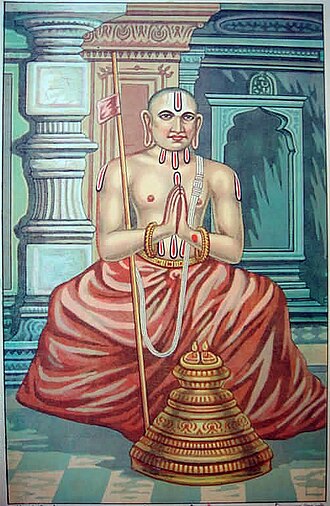
Ramanuja, also known as Ramanujacharya, was an Indian Hindu philosopher, guru and social reformer. He is one of the most important exponents of the Sri Vaishnavism tradition in Hinduism. His philosophical foundations for devotional practice were influential in the Bhakti movement.
"When the food is pure the Sattva element gets purified, the memory becomes unwavering."
Ramanuja"What an individual pursues as a desirable end depends upon what he conceives himself to be."
Ramanuja"Entities other than Brahman can be objects of such cognitions of the nature of joy only to a finite extent and for limited duration. But Brahman is such that cognizing of him is an infinite and abiding joy. It is for this reason that the shruti [scripture] says, `Brahman is bliss’ ( II.6.) Since the form of cognition as joy is determined by its object, Brahman itself is joy."
Ramanuja"The individual self is subject to beginningless nescience, which has brought about an accumulation of karma, of the nature of both merit and demerit. The flood of such karma causes his entry into four kinds of bodies — heavenly, human, animal and plant beginning with that of Brahma downwards. This ingression into bodies produces the delusion of identity with those respective bodies (and the consequent attachments and aversions). This delusion inevitably brings about all the fears inherent in the state of worldly existence. The entire body of Vedanta aims at the annihilation of these fears. To accomplish their annihilation they teach the following:"
Ramanuja"Men, unacquainted with Vedanta, do not see that all things and all individual selves have Brahman as their self. They think that all terms exhaust their significance by signifying the various objects by themselves, which objects are in reality a part and not the whole of the meaning of terms. Now by the study of Vedanta, they understand that all such objects are the effects of Brahman, that Brahman is the inner ruler of them all and that they are animated by Brahman as their very soul. Therefore they come to understand that all terms signify Brahman itself having as its modes the entities, to which latter alone the terms are applied in common usage."
Ramanuja"Ramanuja wrote nine works in Sanskrit on the philosophy of . Of these, the Vedartha-Sangraha occupies a unique place in as much as this work takes the place of a commentary on the , though not in a conventional sense or form. The work mirrors a total vision of the Upanishads, discussing all the controversial texts in a relevant, coherent manner."
Ramanuja"Raamaanuja (aacaarya), the eleventh century South Indian philosopher, is the chief proponent of Vishishtaadvaita, which is one of the three main forms of the Orthodox Hindu philosophical school, Vedaanta As the prime philosopher of the Vishishtaadvaita tradition, Raamaanuja is one of the Indian philosophical tradition’s most important and influential figures He was the first Indian philosopher to provide a systematic theistic interpretation of the philosophy of the Vedas, and is famous for arguing for the epistemic and soteriological significance of bhakti, or devotion to a personal God"
Ramanuja