Quote
"White Democrats opposed Reconstruction not because it was a failure, but because it was working. Today almost all historians of Reconstruction hold that view."
 Reconstruction era
Reconstruction era
Reconstruction era
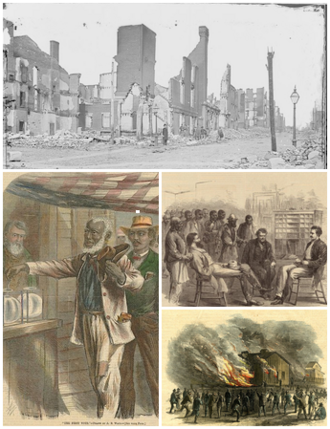
The Reconstruction era, often simply called Reconstruction, was a period in United States history that followed the American Civil War (1861–1865) and was dominated by the legal, social, and political challenges of the abolition of slavery and federal control over, and reintegration of, the former Confederate States into the United States. Three amendments were added to the United States Constitut
"White Democrats opposed Reconstruction not because it was a failure, but because it was working. Today almost all historians of Reconstruction hold that view."
Reconstruction era"But Booth’s assassination of Lincoln was also part of a larger plot to throw the North into chaos. Thus the killing could be called equal parts terrorism and tyrannicide. What is clear is that Lincoln died a martyr to many Northerners and that his death complicated efforts to heal the Union. What followed has become known as Reconstruction, the period from 1865 to 1877 during which Northern Republicans, driven by anger over Lincoln’s assassination and the need to make wartime sacrifices meaningful, sought to “reconstruct” the South as an egalitarian society. Among historians, it is now commonly understood as nothing less than a revolution. Therefore the violence of the Ku Klux Klan and other white supremacists was essentially a counterrevolution, one of the best historical examples of terrorism used in a fundamentally “conservative” cause, that is, with the goal of halting radical change. Most disturbingly, Reconstruction-era terrorism helped facilitate its perpetrators’ victory."
Reconstruction era"The Fifteenth Amendment was passed by Congress and ratified during the Reconstruction Era, when the progressive wing of the Republican Party dominated Congress during the decade following the end of the U.S. Civil War. The Reconstruction era was noteworthy in that African American men were not only granted voting rights but even won several seats in Congress. Hiram Revels and Blanche Bruce became the first African Americans to be elected to the U.S. Senate, representing the state of Mississippi. After their terms in office the next Black person elected to the Senate was Edward Brooke of Massachusetts, nearly a century later in 1967. When Reconstruction collapsed with the withdrawal of Federal troops from the former Confederate states in 1877, the white supremacist wing of the Democratic Party dominated the South. Voting rights for Black men in the former Confederate states were rescinded in courts and in state and local laws, and those rights were further restricted by poll taxes, literacy tests, intimidation, and fraud. The infamous “grandfather clause,” which restricted voting rights to men who were allowed to vote, or whose male ancestors were allowed to vote, before 1867 was also a popular method of disenfranchising African American men - because they were not allowed to vote before the 15th Amendment was ratified, the grandfather clause denied them their voting rights."
Reconstruction era