SHAWORDS
Richard Holbrooke

Richard Holbrooke

Richard Holbrooke

Richard Holbrooke

author
15Quotes

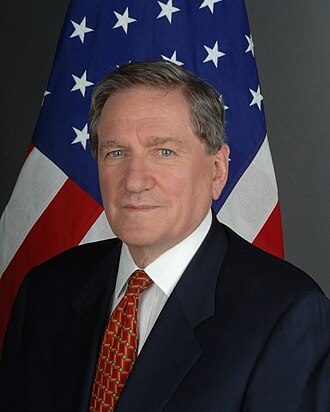
Richard Charles Albert Holbrooke was an American diplomat and author. He was the only person to have held the position of Assistant Secretary of State for two different regions of the world, assisting in brokering a peace agreement among the warring factions in Bosnia leading to the signing of the Dayton Peace Accords. Holbrooke was a prime contender to succeed Warren Christopher as Secretary of S

Popular Quotes

15 total
Quote
"My first stop in Rome was a call on an old friend, Foreign Minister Susanna Agnelli. Universally known as Sunni, she had been appointed to the post by the government of Lamberto Dini in part because of her personal stature. A former mayor and senator, the sister of Italys most famous businessman, Gianni Agnelli, and the author of a best-selling memoir with the delightful title We always wore sailor suits, Sunni Agnelli combined aristocratic bearing with casual informality. Her giant white mane of hair and her imposing height added to her presence. She approached her job as she had probably approached everything else: with a relaxed confidence in her own intuition. She conveyed an impression of great amusement at the passing parade of overly intense men formulating policy. We had known each other for years, but only socially."
Richard HolbrookeRichard Holbrooke
Quote
"To further weaken Pale, I proposed that the Dayton agreement include a provision moving the Bosnian Serb capital to Banja Luka. Milosevic seemed interested in this proposal but, to my surprise, Izetbegovic demurred. Even though he hated the leadership in Pale, he seemed to think he could work with them, especially his old associate from the Bosnian Assembly, Momcilo Krajisnik. Izetbegovic also saw value in keeping the capitals of the two entities close to each other so that Sarajevo remained the only important political center in Bosnia. He may also have feared that if the Bosnian Serb capital moved to Banja Luka, which is closer to Zagreb than Sarajevo, it would accelerate the permanent division of the country and only strengthen Tudjman. Whatever Izetbegovics reasons for not wanting to close Pale, it was a mistake. The mountain town was solely a wartime capital, established by an indicted war criminal and his henchmen. It was the living symbol - and headquarter - of his organization. We should have pushed Izetbegovic harder to agree to establish the Serb capital at Banja Luka. It would have made a big difference in the effort to implement the Dayton agreements."
Richard HolbrookeRichard Holbrooke
Quote
"Shattuck and I were particularly concerned with the activities of Zeljko Raznatovic, popularly known as Arkan, one of the most notorious men in the Balkans. Even in former Yugoslavia, Arkan was something special, a freelance murderer who roamed across Bosnia and eastern Slavonia with his black-shirted men, terrorizing Muslims and Croats. To the rest of the world Arkan was a racist fanatic run amok, but many Serbs regarded him as a hero. His private army, the Tigers, had committed some of the wars worst atrocities, carrying out summary executions and virtually inventing ethnic cleansing in 1991-92. Western intelligence was convinced he worked, or had worked, for the Yugoslav secret police. (...) Although the [Hague ICTY] Tribunal had handed down over fifty indictments by October 1995, these did not include Arkan. I pressed Goldstone [Richard Goldstone, ICTY president] on this matter several times, but because a strict wall separated the tribunals internal deliberations from the American government, he would not tell us why Arkan had not been indicted. This was especially puzzling given Goldstones stature and his public criticisms of the international peacekeeping forces for not arresting any of the indicted war criminals. Whenever I mentioned Arkans name to Milosevic, he seemed annoyed. He did not mind criticism of Karadzic or Mladic, but Arkan - who lived in Belgrade, ran a popular restaurant, and was married to a rock star - was a different matter. Milosevic dismissed Arkan as a "peanut issue", and claimed he had no influence over him. But Arkans activities in western Bosnia decreased immediately after my complaints. This was hardly a victory, however, because Arkan at large remained a dangerous force and a powerful signal that one could still get away with murder - literally - in Bosnia."
Richard HolbrookeRichard Holbrooke
Quote
"Most American officials viewed Prime Minister Haris Silajdzic as the Bosnia leader with the broadest vision - an eloquent advocate of a multiethnic state. But his power struggles with Izetbegović and Sacirbey and other members of the Bosnian government often isolated him. His collegues complained that he was difficult to work with. He carried a serious additional burden: Tuđman and Milošević distrusted him. Nevertheless, Silajzic was one of the two most popular Muslim politicians in Bosnia, along with Izetbegović. My own feelings about Silajdzic shifted frequently. There was something touching about his intensity and energy, and his constant desire to improve himself intellectually. Although always busy, he seemed alone - his wife and son lived in Turkey. Silajdzic was the only Bosnian official who seemed genuinely to care about economic reconstruction of his ravaged land. His unpredictable moods worried us, but his support would be essential for any peace agreement."
Richard HolbrookeRichard Holbrooke
Quote
"A remarkable challenge to Milosevic unfolded in the street of Belgrade in December [1996], led by three politicians who banded together in a movement called Zajedno, or the Together Movement. For weeks, hundreds of thousands of Belgrade citizens braved subfreezing weather to call for democracy. But Washington missed a chance to affect events; except for one ineffectual trip to Washington, Zajedno had no contact with senior American government officials, and the Administrations sent no senior officials to Belgrade for fear that their visits would be used by Milosevic to show support. For the first time in eighteen months, Milosevic felt no significant American pressure, and turned back towards the extreme nationalists, including Karadzic, for support. His tactical skills saved him again, and within weeks, the Together Movement was together no more, as its leaders split among themselves."
Richard HolbrookeRichard Holbrooke
Quote
"Its great to be on the stage with my new diplomatic partner, Ambassador Richard Holbrooke. You know, it’s every Commander’s dream to have as his ambassadorial wingman someone journalists describe with nicknames like “The Bulldozer.” In all seriousness, I want to publicly salute this gifted diplomat for taking on his new position, an appointment that conveys how significant the focus is in the United States on Afghanistan and Pakistan and the South and Central Asian regions more broadly."
Richard HolbrookeRichard Holbrooke
Quote
"There was also a real Dayton out there, a charming small Ohio city, famous as the birthplace of the Wright Brothers. Its citizens energized us from the outset. Unlike the population of, say, New York, Geneva or Washington, which would scarcely notice another conference, Daytonians were proud to be part of history. Large signs at the commercial airport hailed Dayton as the "temporary center of international peace". The local newspapers and television stations covered the story from every angle, drawing the people deeper into the proceedings. When we ventured into a restaurant or a shopping center downtown, people crowded around, saying that they were praying for us. Warren Christopher was given at least one standing ovation in a restaurant. Families on the air base placed "candles of peace" in their front windows, and people gathered in peace vigils outside the base. One day they formed a "peace chain", although it was not large enough to surround the sprawling eight-thousand-acre base. Ohios famous ethnic diversity was only on display. We did everything possible to emphasize the fact that in the American heartland people from every part of southeastern Europe lived together in peace, their competition restricted to softball games, church rivalries, and the occasional barroom fight. (...)"
Richard HolbrookeRichard Holbrooke
Quote
"As everybody who met him noted, Krajisnik had only one long and extraordinarily brushy eyebrow, which spanned his forehead, creating what looked like a permanent dark cloud over his deep-set eyes. Although Krajisnik had not been indicted by the War Crimes Tribunal - and could therefore participate in Dayton - it was hard to distinguish his views from those of his close friend Radovan Karadzic. Milosevic had often said that Krajisnik was "more difficult" than Karadzic, but we had little basis on which to make an independent judgment. (...) He and Izetbegovic knew each other well, from lengthy meetings in the Bosnian Assembly before the war. Krajisnik owned a five-hectare farm on the edge of Sarajevo, in an area that would probably revert to the Muslims in any settlement, and we often made bitter jokes that the war was really over "Krajisniks five hectares"."
Richard HolbrookeRichard Holbrooke
Quote
"Our meeting with Admiral Leighton Smith, on the other hand, did not go well. He had been in charge of the NATO air strikes in August and September [1995], and this gave him enormous credibility, especially with the Bosnian Serbs. Smith was also the beneficiary of a skillful public relations effort that cast him as the savior of Bosnia. In a long profile, Newsweek had called him "a complex warrior and civilizer, a latter-day George C. Marshall." This was quite a journalistic stretch, given the fact that Smith considered the civilian aspects of the task beneath him and not his job - quite the opposite of what General Marshall stood for."
Richard HolbrookeRichard Holbrooke
Quote
"The world "legendary" is much overused, but it certainly applies to the seventy-six-year-old Andreas Papandreou, whose life had encompassed so much Greek-American history. As a Greek-born American citizen, he earned a doctorate in economics from Harvard, served in the United States Navy during World War II, and then taught at Harvard, the University of Minnesota, and Berkeley (where he was chairman of the economics department). He was part of Adlai Stevensons advisory team during his two runs for the presidency. Then he returned to Greece and fought his way into power, surviving a long period in the political wilderness after right-wing pressure forced the resignation of his father, Georgios Papandreou, in 1965, two years before the military coup. He won the prime ministership fifteen years after his father had been forced out of it, and then lost it following a series of corruption scandals - only to make another astonishing comeback, regaining it again in 1993. To conservative Americans, he was anathema, an American turncoat. To Greeks, both those who followed him and those who hated him, he was the dominant political figure of the era."
Richard HolbrookeRichard Holbrooke

Similar Authors & Thinkers