Quote
"Im known for speaking my mind, a trait I probably inherited from my parents, Louis and Mary Leakey—neither of whom was renowned for tact."
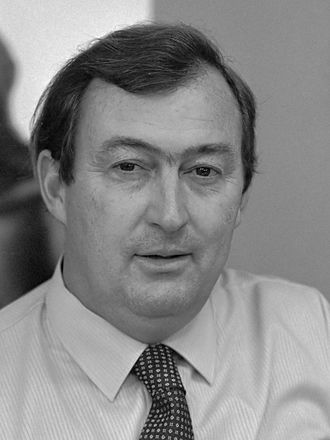 Richard Leakey
Richard Leakey
Richard Leakey
Richard Erskine Frere Leakey was a Kenyan paleoanthropologist, conservationist and politician. Leakey held a number of official positions in Kenya, mostly in institutions of archaeology and wildlife conservation. He was director of the National Museum of Kenya, founded the NGO WildlifeDirect, and was the chairman of the Kenya Wildlife Service. Leakey served in the powerful office of cabinet secret
"Im known for speaking my mind, a trait I probably inherited from my parents, Louis and Mary Leakey—neither of whom was renowned for tact."
Richard Leakey"I do not believe in a god who has or had a human form and to whom I owe my existence. I believe it is the man who created God in his image and not the other way round."
Richard Leakey"A vital leap in the evolution of intellectual capacity would have been the ability to form concepts, to conceive of individual objects as belonging to distinct classes, and thus do away with the almost intolerable burden of relating one experience to another. Concepts, moreover, can be manipulated and this is the root of abstract thought and of invention. The formation of concepts is also a necessary, but apparently not sufficient, condition for the emergence of language."
Richard Leakey"I think both Louis and I were looking for more or less the same thing, and that is, when did our species, Homo, begin?"
Richard Leakey"Ever since Darwin tied knots between human beings and the rest of the animal world, many people have frantically attempted to untie them again, declaring that even though our roots are in the animal world we have left them so far behind as to make any comparisons utterly meaningless. To some extent this is true, because the quality that makes us unique in the biological kingdom is the enormous capacity to learn."
Richard Leakey"In its extreme form self-awareness manifests itself in notions such as that of the soul, but in simple form it merely means to be aware of oneself as an individual among others."
Richard Leakey"To our western eyes, the painted images are the most prominent component of a corpus of artistic expression. This Western bias, a particularly Eurocentric bias, has been pervasive and deep. ...it has resulted in a lack of attention to, and concern about, prehistoric art of equal and sometimes greater antiquity in eastern and southern Africa."
Richard Leakey"Because the art of Africa was on rock shelters, not deep in caves, as in Europe, the ravages of time have eroded most of a rich expression. What we now see is the merest glimpse of what was on the minds of these people."
Richard Leakey"The painted, engraved, and carved images of prehistory are threads from past cultures, and we are foreigners trying to interpret their meaning. Perhaps more than anything else, art can be fully understood only in the context of the culture that produced it."
Richard Leakey"The Abbé Breuil died in 1961, and with him died the all-encompassing hunting magic hypothesis. By this time another French archeologist, André Leroi-Gourhan, had been developing his own interpretation, one based on the emerging ideas on structuralism."
Richard Leakey"The first major discovery of prehistoric art was the Spanish cave of Altamira, which, like Lascaux, is one of the most spectacular examples of Upper Paleolithic art yet known."
Richard Leakey"Protecting elephants and conserving natural ecosystems remain my personal priorities. But I am not so sure this would be so were I ill, hungry, and living in dispair. ...We must somehow find a way to provide for our own species if we are also to preserve others."
Richard Leakey