Quote
"At the beginning of the new millennium the most famous unsolved problem in complex analysis, if not in all of mathematics, is to determine whether the Riemann hypothesis holds."
 Riemann hypothesis
Riemann hypothesis
Riemann hypothesis
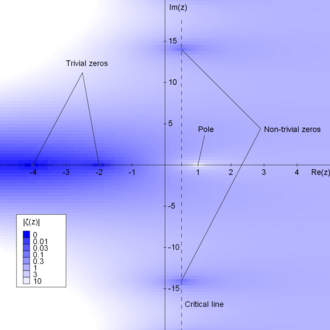
In mathematics, the Riemann hypothesis is the conjecture that the Riemann zeta function has its zeros only at the negative even integers and complex numbers with real part 1/2. Many consider it to be the most important unsolved problem in pure mathematics. It is of great interest in number theory because it implies results about the distribution of prime numbers. It was proposed by Bernhard Riem
"At the beginning of the new millennium the most famous unsolved problem in complex analysis, if not in all of mathematics, is to determine whether the Riemann hypothesis holds."
Riemann hypothesis"Hilbert, in his 1900 address to the Paris , listed the Riemann Hypothesis as one of his 23 problems for mathematicians of the twentieth century to work on. Now we find it is up to twenty-first century mathematicians! The Riemann Hypothesis (RH) has been around for more than 140 years, and yet now is arguably the most exciting time in its history to be working on RH. Recent years have seen an explosion of research stemming from the confluence of several areas of mathematics and physics."
Riemann hypothesis"A substantial portion of Weil’s research was motivated by an effort to prove the Riemann hypothesis concerning the zeroes of the Riemann zeta function. He was continually looking for new ideas from other fields that he could bring to bear on a proof. He commented on this matter in a 1979 interview:... Asked what theorem he most wished he had proved, he responded, “In the past it sometimes occurred to me that if I could prove the Riemann hypothesis, which was formulated in 1859, I would keep it secret in order to be able to reveal it only on the occasion of its centenary in 1959. Since 1959, I have felt that I am quite far from it; I have gradually given up, not without regret.”"
Riemann hypothesis"I believe that the vast majority of statements about the integers are totally and permanently beyond proof in any reasonable system. Here I am using proof in the sense that mathematicians use that word. Can statistical evidence be regarded as proof ? I would like to have an open mind, and say ‘Why not?’. If the first ten billion zeros of the zeta function lie on the line whose real part is 1/2, what conclusion shall we draw? I feel incompetent even to speculate on how future generations will regard numerical evidence of this kind."
Riemann hypothesis"The Riemann hypothesis is, and will hopefully remain for a long time, a great motivation to uncover and explore new parts of the mathematical world. After reviewing its impact on the development of we discuss three strategies, working concretely at the level of the explicit formulas. The first strategy is “analytic” and is based on Riemannian spaces and and its comparison with the explicit formulas. The second is based on algebraic geometry and the . We establish a framework in which one can transpose many of the ingredients of the Weil proof as reformulated by , Tate and Grothendieck. This framework is elaborate and involves noncommutative geometry, es and . We point out the remaining difficulties and show that RH gives a strong motivation to develop algebraic geometry in the emerging world of characteristic one. Finally we briefly discuss a third strategy based on the development of a suitable “”, the role of Segal’s Γ-rings and of topological cyclic homology as a model for “absolute algebra” and as a cohomological tool."
Riemann hypothesis"It tells us that they are very nicely distributed, about as evenly and as good as altogether possible. One cannot expect a completely even distribution, of course. But it tells us that at least in mathematics, certainly in number theory, we live in Leibniz’ “best possible of all worlds”, just as the good Candide in Voltaire’s is told by his teacher that he lives in the best of all possible worlds. Well, in number theory at least, one has the best relation possible among primes, even though we cannot prove it yet. It would give me great satisfaction to see a proof, because it would demonstrate that there are some things that are right in this world. There are so many other things that do not work as they should, but at least for the prime numbers, and of course also for the zeros of the zeta function, they are distributed as well as they could be."
Riemann hypothesis"The dependence of so many results on Riemanns challenge is why mathematicians refer to it as a hypothesis rather than a conjecture. The word hypothesis has the much stronger connotation of a necessary assumption that a mathematician makes in order to build a theory. Conjecture, in contrast, represents simply a prediction of how mathematicians believe their world behaves. Many have had to accept their inability to solve Riemanns riddle and have simply adopted his prediction as a working hypothesis. If someone can turn the hypothesis into a theorem, all those unproven results would be validated."
Riemann hypothesis




