Quote
"Theorem of the equivalence of Heat and Work. ...Mechanical work may be transformed into heat, and conversely heat into work, the magnitude of the of the one being always proportional to that of the other."
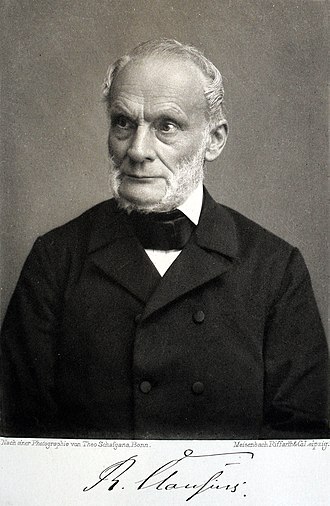 Rudolf Clausius
Rudolf Clausius
Rudolf Clausius
Rudolf Julius Emanuel Clausius was a German physicist and mathematician and is considered one of the central founding fathers of the science of thermodynamics. By his restatement of Sadi Carnot's principle known as the Carnot cycle, he gave the theory of heat a truer and sounder basis. His most important paper, "On the Moving Force of Heat", published in 1850, first stated the basic ideas of the s
"Theorem of the equivalence of Heat and Work. ...Mechanical work may be transformed into heat, and conversely heat into work, the magnitude of the of the one being always proportional to that of the other."
Rudolf Clausius"Carnot proves that whenever work is produced by heat... a... quantity of heat passes from a warm body to... cold... [e.g.,] the vapour... generated in the of a steam-engine... passes... to the condenser where it is precipitated... This transmission Carnot regards as the change of heat corresponding to the work... He says... no heat is lost in the process, that... [its] quantity remains unchanged; and he adds, "This is a fact... never... disputed... confirmed by various calorimetric experiments. To deny it, would be to reject the entire theory of heat, of which it forms the principal foundation.""
Rudolf Clausius"In their calculations, Clausius (and Waterston, for that matter) had imagined all atoms in a gas moving at the same speed. They knew this wasnt true... but they didnt have the mathematical sophistication to tackle the full problem. Maxwell... defined a mathematical function called the distribution of velocities, which kept track of how many atoms were moving at any particular speed relative to the average, and by dealing in terms of this distribution... was able to give his calculations a precision that those of Clausius lacked."
Rudolf Clausius"[T]he equivalence-value of the transformation of work into the quantity of heat Q, of the temperature t, may be represented... wherein f(t) is...[the same] function of the temperature... for all cases. When Q is negative... it will indicate that the quantity... transformed... from heat into work."
Rudolf Clausius"This principle, upon which the whole of the following development rests, is... Heat can never pass from a colder to a warmer body without some other change, connected therewith, occurring at the same time. Everything we know the interchange of heat between two bodies of different temperatures confirms this; for heat everywhere manifests a tendency to equalize existing differences of temperature..."
Rudolf Clausius"[T]he new theory is opposed, not to the real fundamental principle of Carnot, but to the addition "no heat is lost;" for it is... possible that in the production of work... a certain portion of heat may be consumed, and a further portion transmitted from a warm body to a cold one; and both portions may stand in a certain definite relation to the quantity of work produced."
Rudolf Clausius"The careful experiments of Joule, who developed heat... by the application of mechanical force, establish... not only the possibility of increasing the quantity of heat, but also the fact that the newly-produced heat is proportional to the work expended in its production."
Rudolf Clausius"[M]any facts have lately transpired which tend to overthrow the hypothesis that heat is itself a body, and to prove that it consists in a motion of the ultimate particles of bodies. If this be so, the general principles of mechanics may be applied to heat; this motion may be converted into work, the loss of in each particular case being proportional to the quantity of work produced. These circumstances, of which Carnot was also well aware, and the importance of which he expressly admitted, pressingly demand a comparison between heat and work, to be undertaken with reference to the divergent assumption that the production of work is not only due to an alteration in the distribution of heat, but to an actual consumption thereof; and inversely, that by the expenditure of work, heat may be produced."
Rudolf Clausius"When the several changes are... such... that... the body returns to its original condition... these changes form a cyclical process, we haveand..."
Rudolf Clausius"[T]he entire quantity of heat, Q, absorbed by the gas during a change of volume and temperature may be decomposed into two portions. One of these, U, which comprises the sensible heat and the heat necessary for interior work, if... present... determined by the state of the gas at the beginning and at the end of the alteration; while the other portion... the heat expended on exterior work, depends, not only upon the state of the gas at these two limits but also upon the manner in which the alterations have been effected..."
Rudolf Clausius"The s... may be divided into two classes: those which the atoms of a body exert upon each other... which depend... upon the nature of the body, and those which arise from the foreign influences to which the body may be exposed. According to these two classes of forces... I have divided the work done by heat into interior and exterior work."
Rudolf Clausius"[W]e may consider the as well as the whole condition of the body... as determined so soon as its t and v are given. We... make these two magnitudes... independent variables, and... consider the pressure p as well as the quantity U... as functions of these. If... t and v receive the increments dt and dv, the corresponding quantity of exterior work done... during an increment of volume dv will be pdv. Hence... and... we obtain"
Rudolf Clausius




