Quote
"Tis the procession of a funeral vow, Which cruel laws to Indian wives allow, When fatally their virtue they approve; Cheerful in flames, and martyrs of their love."
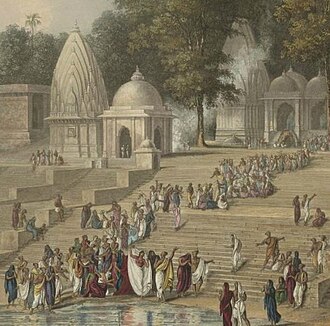 Sati (practice)
Sati (practice)
Sati (practice)
Sati or suttee is a chiefly historical Hindu practice in which a widow burns alive on her deceased husband's funeral pyre, either voluntarily, by coercion, or by a perception of the lack of satisfactory options for continuing to live. Although it is debated whether it received scriptural mention in early Hinduism, it has been linked to related Hindu practices in the Indo-Aryan-speaking regions of
"Tis the procession of a funeral vow, Which cruel laws to Indian wives allow, When fatally their virtue they approve; Cheerful in flames, and martyrs of their love."
Sati (practice)"12 November 1623 – ... As we returnd home at night, we met a Woman in the City of Ikkerì, who, her Husband being dead, was resolvd to burn her self, as tis the custom with many Indian Women. She rod on Horse-back about the City with open face, holding a Looking-glasse in one hand, and a Lemon in the other, I know not for what purpose; and beholding her self in the Glass, with a lamentable tone sufficiently pittiful to hear, went along I know not whither speaking or singing certain words, which I understood not; but they told me, they were a kind of Farewell to the World and her self; and indeed, being utterd with that passionateness which the Case requird and might produce, they movd pity in all that heard them, even in us who understood not the Language. She was followd by many other Women and Men on foot, who, perhaps, were her Relations; they carryd a great Umbrella over her, as all Persons of quality in India are wont to have, thereby to keep off the Sun, whose heat is hurtful and troublesome. Before her, certain Drums were sounded, whose noise she never ceasd to accompany with her sad Ditties or Songs; yet with a calm and constant Countenance, without tears, evidencing more grief for her Husbands death then her own, and more desire to go to him in the other world than regret for her own departure out of this: A Custom, indeed, cruel and barbarous, but withall, of great generosity and virtue in such Women, and therefore worthy of no small praise. They said, she was to pass in this manner about the City, I know not how many dayes, at the end of which she was to go out of the City and be burnt, with more company and solemnity. If I can know when it will be, I will not fail to go to see her, and by my presence honor her Funeral, with that compassionate affection which so great Conjugal Fidelity and Love seems to me to deserve."
Sati (practice)"Yea, I am persuaded, that the English breast has not a more joyous sensation on seeing the launch of a ship, than these inhuman beings experienced at the launch of an immortal spirit, loaded with all its aggravated sins, into an awful eternity!"
Sati (practice)"She chose her ruin, and resignd her life, In death undaunted as an Indian wife."
Sati (practice)"A word may here be said about the important though cruel customs of Sati and Jauhar prevailing in medieval times. With the loss of power and constant danger of attack, the customs of Sati and Jauhar were gaining strong roots not only among the Kshatriyas, but among other people also. However, the most significant fact about these customs is that except perhaps by Muhammad Tughlaq, no serious attempt was made to put a stop to such an inhuman system of self-immolation. On the other hand it was universally admired. Even an extremely cultured man like Amir Khusru exclaimed: “See how noble it is”. Ibn Battiita witnessed the Sati on many occasions and gives many unhappy details. Jauhar was prevalent both in the north and the south. During Timir’s invasion Muslim women also performed Jauhar when Bhatnir was sacked.”"
Sati (practice)"The mythological origin of the practice comes from the story of the goddess Sati, who burned herself to protest her father’s insult to Shiva. However, formal widow burning emerged later, especially among elite Rajput clans during medieval India, and was often linked to notions of honor, purity, and loyalty. Widows who committed sati were believed to become goddesses, and their cremation sites were marked with memorial stones or temples. …Sati must be understood as both a religious rite and a social imposition. While some women may have embraced it as a path to spiritual purity, others were coerced or lacked alternatives. …Modern scholarship emphasizes the need to distinguish between voluntary religious acts and socially enforced violence. Sati’s legacy continues to provoke debates about agency, tradition, and the limits of religious freedom."
Sati (practice)"They [the Mughals] do not, indeed, forbid it (sati) by a positive law, because it is a part of their policy to leave the idolatrous population, which is so much more numerous than their own, in the free exercise of its religion; but the practice is checked by indirect means"
Sati (practice)




