SHAWORDS
Seaweed farming

Seaweed farming

Seaweed farming

Seaweed farming

author
3Quotes

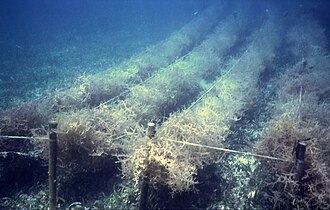
Seaweed farming or kelp farming is the practice of cultivating and harvesting seaweed. In its simplest form farmers gather from natural beds, while at the other extreme farmers fully control the crop's life cycle.

Popular Quotes

3 total
Quote
"The usage of macroalgae in traditional food and was recorded in early Neolithic data of ten thousand years back. Being naturally enriched in key nutrients and in various health-promoting compounds, they are traditionally consumed in many Asian countries like China, Indonesia, Philippine, South Korea, North Korea, Japan and Malaysia for centuries. Recently, they have attained more reputation in western countries. Seaweeds promising candidates for the design of functional foods have become key foods in current nutritional practices (vegetarian, vegans, health-foods, etc.) and are increasingly widely consumed in the USA, South American and European countries. Global demands for seaweeds has been growing together with increases in usage beyond former traditional applications. According to statistics of the most cultivated seaweed taxa, three were used mainly for extraction: spp. and for s, and spp. for ; , , spp. and were the most important in human food usage. The main producing countries were China, Indonesia and the Philippines."
Seaweed farmingSeaweed farming
Quote
"Seaweed aquaculture, the fastest-growing component of global food production, offers a slate of opportunities to mitigate, and adapt to . Seaweed farms release carbon that may be buried in sediments or exported to the deep sea, therefore acting as a . The crop can also be used, in total or in part, for production, with a potential CO2 mitigation capacity, in terms of avoided emissions from fossil fuels, of about 1,500 tons CO2 km−2 year−1. Seaweed aquaculture can also help reduce the emissions from agriculture, by improving soil quality substituting synthetic fertilizer and when included in cattle fed, lowering methane emissions from cattle."
Seaweed farmingSeaweed farming
Quote
"An is a nonparasitic plant that dwells on another plant and has been well studied in terrestrial plants. However, in the , these epiphytes thrive on algal thallus for their support and growth, and their infestation has a prime economic impediment in commercial cultivation. They usually belong to various groups, namely, bacteria, fungi, algae, ascidians, bryozoans, sponges, protozoa, molluscs, crustaceans, and other marine sessile organisms. The seaweed farming industry is currently growing at ca. 9% per annum, with global production of 31.2 million wet tons worth US$ 11.7 billion. The first report of an epiphytic outbreak in commercial farms of Kappaphycus in the 1970s caught the attention of several researchers on this devastating epiphyte which causes retarded growth and significant loss of stocking biomass, ultimately leading to the production of inferior quality of raw material. High-density planting in commercial farms is often responsible for recurring epiphytic infestations."
Seaweed farmingSeaweed farming

Similar Authors & Thinkers



