SHAWORDS
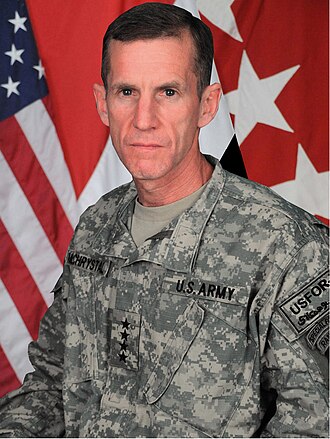
Stanley A. McChrystal

Stanley A. McChrystal
Stanley A. McChrystal

Stanley A. McChrystal
author
32Quotes

Stanley Allen McChrystal is a retired United States Army general best known for his command of Joint Special Operations Command (JSOC) from 2003 to 2008 during which his organization was credited with the elimination of Abu Musab al-Zarqawi, leader of al-Qaeda in Iraq. His final assignment was as Commander, International Security Assistance Force (ISAF) and Commander, United States Forces – Afghan

Popular Quotes

32 total
Quote
"Service in this business is tough and often dangerous. It extracts a price for participants, and that price can be high. It is tempting to protect yourself from the personal and professional cost of loss by limiting how much you commit, how much you believe and trust in people, and how deeply you care… If I had it to do over again, I’d do some things in my career differently, but not many. I believed in people and I still believe in them. I trusted and I still trust. I cared and I still care. I wouldn’t have had it any other way."
Stanley A. McChrystalStanley A. McChrystal
Quote
"On Wednesday, June 2, 1976, I graduated and my father commissioned me as a second lieutenant. Our graduation ceremony was where wed begun our cadet experience, at Michie Stadium. As I sat with 834 other members of my class, out of an original 1,378, waiting to receive our diplomas, I realized I was very different from the seventeen-year-old boy whose friend had dropped him off a few years earlier. I wondered if I could, or would, be the kind of military leader I admired, and I was eager to try. When the ceremony ended, in accordance with tradition, we launched our hats into the air and congratulated one another. I rapidly looked for Annie- and the exit. As quickly as possible, I threw everything I owned into the used Chevy Vega Id bought and set course with Annie down the hill away from campus. As we neared the last bend before the academy gates, I turned to her. "Hey, look back at West Point." "Why?" she asked, twisting in her seat to look at the tips of the parapets getting smaller behind the hills. "Because thats the last time well ever see it."
Stanley A. McChrystalStanley A. McChrystal
Quote
"While I had enjoyed other jobs, I loved command. I had been in a command position for ten of the previous twenty-six years. But each new position was initially daunting. As I suspect many leaders feel, I was never sure if I could command at the next level until I actually assumed the job. I remembered how Douglas Southall Freeman, in Lees Lieutenants, had described Lees challenges in determining which brigade commanders could actually handle the responsibilities of a division or corps. The most aggressive brigade commanders often lacked the intangible qualities required for more senior leadership. Of course I often wondered about myself. As the demands of the positions differed, I found that I had changed as a leader. I learned to ask myself two questions: First, what must the organization I command do and be? And second, how can I best command to achieve that? Experience taught me that many factors would shape my "command style," and it would be some time before I had settled into it."
Stanley A. McChrystalStanley A. McChrystal
Quote
"At the heart of the story is Afghanistan itself, a complex swirl of ethnic and political rivalries, cultural intransigence, strains of religious fervor, and bitter memories overlaid on a beautiful, but harshly poor, landscape. Without internal struggles or outside influence, Afghanistan would be a difficult place to govern, and a challenge to develop. And there have always been struggles and interference. But its not just that. In her beauty and coarseness, in her complexity and tragedy Afghanistan possesses a mystical quality, a magnetism. Few places have such accumulated layers of culture, religion, history, and lore that instill both fear and awe. Yet those who seek to budge her trajectory are reminded that dreams often end up buried in the barren slopes of the Hindu Kush or in muddy fields alongside the Helmand River."
Stanley A. McChrystalStanley A. McChrystal
Quote
"When I arrived to take command of the war in June 2009, in addition to the rising violence and sense of insecurity, I found a creeping, fatalistic pessimism, as though the fight were over, the effort failed. Some pointed to history and declared the country intractable. Few countries or NGOs were leaving, but many wanted to. There was growing unease with the viability of the mission. Indeed, in those early days, as I assessed the war, I wasnt sure the mission could be done. Although Id known it would be difficult, the situation was even worse than Id anticipated. I was further cautioned by the fact that I would be the twelfth commander to lead the NATO effort in Afghanistan, the latest in a succession of experienced professionals. Any solution would not only be a military one; it had to encompass much more. But as we looked closer and considered a range of strategies, I concluded that it was possible. The intimidating specter of Afghanistan as an impossible challenge belied the reality. The obstacles were numerous, but the accrued problems were not insoluble, just incredibly difficult."
Stanley A. McChrystalStanley A. McChrystal
Quote
"On May 19, 2009, I was taken to the White House to meet President Obama. Wed met once before when hed visited the Pentagon during his first week in office, but as DJS Id been in a collection of other civilian and military leaders, so it was unlikely he remembered the man who would soon command his military effort in Afghanistan. Id been in the Oval Office before with President George W. Bush, but the atmosphere in the West Wing in the final and opening months of administrations differed perceptibly. Although it was four months into Obamas term, there was still a feeling of newness to the people, who moved with an air of excited purpose through the hallways. When the president was available, the door opened and Obama walked to the entrance to greet me into the room. The meeting was short, but cordial. The president offered no specific guidance but locked his eyes with mine and thanked me for accepting the responsibility."
Stanley A. McChrystalStanley A. McChrystal
Quote
"People are born; leaders are made. I was born the son of a leader with a clear path to a profession of leadership. But whatever leadership I later possessed, I learned from others. I grew up in a household of overt values, many of which hardened in me only as I matured. Although history fascinated me, and mentors surrounded me, the overall direction and key decisions of my life and career were rarely impacted by specific advice, or even a particularly relevant example Id read or seen. I rarely wondered What would Nelson, Buford, Grant, or my father have done? But as I grew, I was increasingly aware of the guideposts and guardrails that leaders had set for me, often through their examples. The question became What kind of leader have I decided to be? Over time, decisions came easily against that standard, even when the consequences were grave."
Stanley A. McChrystalStanley A. McChrystal
Quote
"In the end, leadership is a choice. Rank, authority, and even responsibility can be inherited or assigned, whether or not an individual desires or deserves them. Even the mantle of leadership occasionally falls to people who havent sought it. But actually leading is different. A leader decides to accept responsibility for others in a way that assumes stewardship of their hopes, their dreams, and sometimes their very lives. It can be a crushing burden, but I found it an indescribable honor."
Stanley A. McChrystalStanley A. McChrystal
Quote
"When the ceremony ended Anne and I stayed on the field to greet friends, many of whom had traveled to share the ceremony with us. In one respect it was a difficult day at the end of a difficult month. But in the broader view of life, it was a magical evening at the end of an incredible journey we shared. We walked back over to the quarters we would move out of a few days later, and found friends in the yard and almost every room. At one point I saw Mike Hall, Charlie Flynn, Shawn Lowery, and Casey Welch standing in the fading summer light. I thought of my father, of my first day at West Point, and of our cold Christmas Eve flight over Afghanistan seven months before. The final words of my last speech in uniform, spoken just an hour before were repeated in my mind: "If I had it to do over again, Id do some things in my career differently, but not many. I believed in people, and I still believe in them. I trusted and I still trust. I cared and I still care. I wouldnt have it any other way... To the young leaders of today and tomorrow, its a great life. Thank you."
Stanley A. McChrystalStanley A. McChrystal
Quote
"For a boy whod grown up on stories of legionnaires, it was easy to feel the thick spirit that filled this small outpost, home to the parachute battalion that had this corner of the fight. I had come to thank them for their service and their courage. Talking to young soldiers, some already seasoned warriors, who had purposely selected a life of expeditionary service, I thought of their predecessors in Indochina and Algeria. I looked over at two of my aides, one a German officer, another an Afghan. How different wars could be, I thought, but the soldiers seemed the same."
Stanley A. McChrystalStanley A. McChrystal

Similar Authors & Thinkers